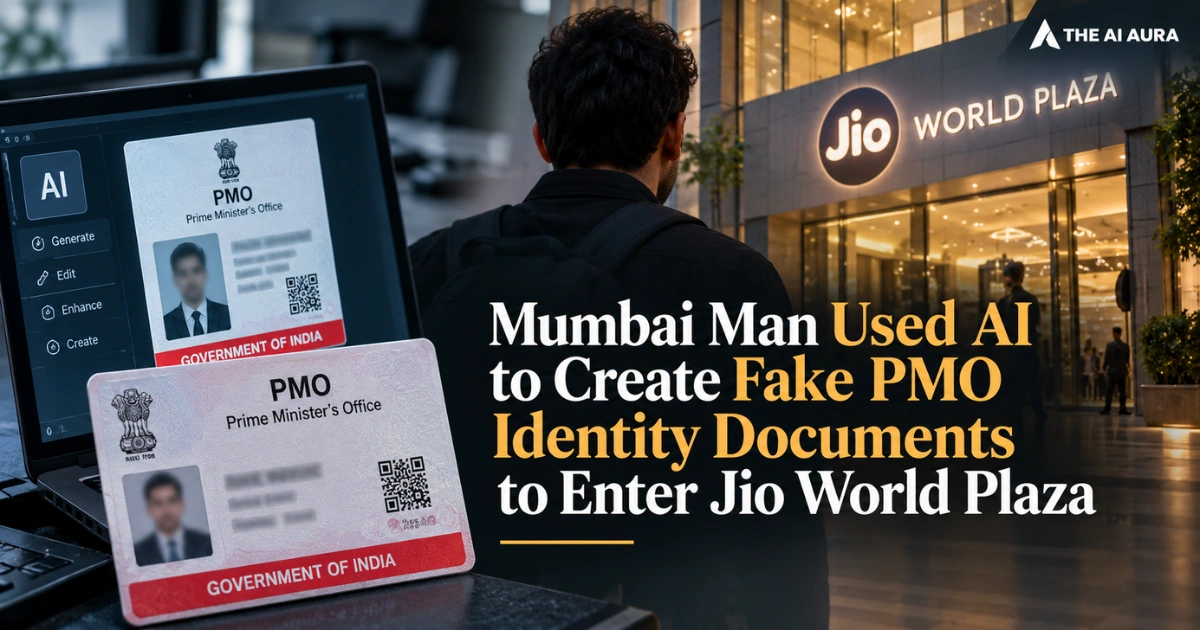

A 24-year-old Mumbai resident, Rohan Parikh, bypassed standard security protocols at the Jio World Plaza in BKC by leveraging ChatGPT to generate highly convincing, fabricated Prime Minister’s Office (PMO) credentials.
Accompanied by an armed private bodyguard, Parikh executed the breach on September 7, just days ahead of a scheduled visit by Prime Minister Narendra Modi. Parikh explicitly engineered these digital documents over the past year to artificially elevate his social standing, intimidate personnel, and bypass exclusive venue restrictions.
The Mechanics of AI-Assisted Forgery
The scheme combined generative AI tools with aggressive social engineering tactics. The Crime Intelligence Unit (CIU) raided Parikh’s residence in Khar. Officers seized a laptop, a hard drive, and a Redmi 5G smartphone. Digital forensics revealed a steady pattern of queries aimed at formatting government correspondence.
Parikh did not just print a fake badge; he utilized ChatGPT to draft authentic-sounding PMO directives and mandates, adopting the distinct bureaucratic lexicon required to pass a visual inspection.
The tool helped him adopt the bureaucratic tone needed to pass visual inspections. When security stopped him at Jio World Plaza, he avoided physical badge flaws. Instead, he displayed a digital PMO ID card directly on his phone screen.
This tactic exploits the psychological weight of government authority security personnel are heavily deterred from demanding physical verification when presented with official-looking digital credentials accompanied by an armed guard.
To complete the illusion of high-level VIP status, Parikh hired Dilip Kunde, a 37-year-old ex-Army personnel. Kunde carried a firearm legally obtained for personal protection but was actively repurposing it for commercial bodyguard duties.
The presence of a legitimate, armed security detail effectively validated the AI-generated credentials to the plaza’s frontline staff. A third accomplice, Prathmesh Bagul, was also present during the infiltration but managed to flee the scene and remains wanted by law enforcement.
Legal Proceedings and Security Fallout
The security breach triggered an immediate high-level response due to the proximity of the Prime Minister’s itinerary. Following their arrest, Parikh and Kunde were presented before the 37th Metropolitan Magistrate, D S Khedekar. The CIU transitioned the accused from police to judicial custody, shifting the investigation’s focus entirely to electronic evidence analysis.
Investigators are currently mapping the exact extent of Parikh’s AI usage dating back to 2025. The core objective is to determine if these forged PMO credentials facilitated access to other high-security zones, influenced financial transactions, or were used to defraud individuals prior to the Jio World Plaza incident.
Police are also conducting a separate investigation into Kunde’s commercial deployment of a personal-use firearm.
High-profile defense attorney Satish Maneshinde has filed bail applications for both men. The court mandated the police to file their official reply, adjourning the bail hearing to September 17, 2026.
The CIU retains the seized electronic devices to extract the complete log of generative AI prompts used to manufacture the fake government identity.
Source: The Times of India, "Mumbai Mall Entry Case: Man Used ChatGPT to Create Fake PMO Documents, Police Tell Court"