
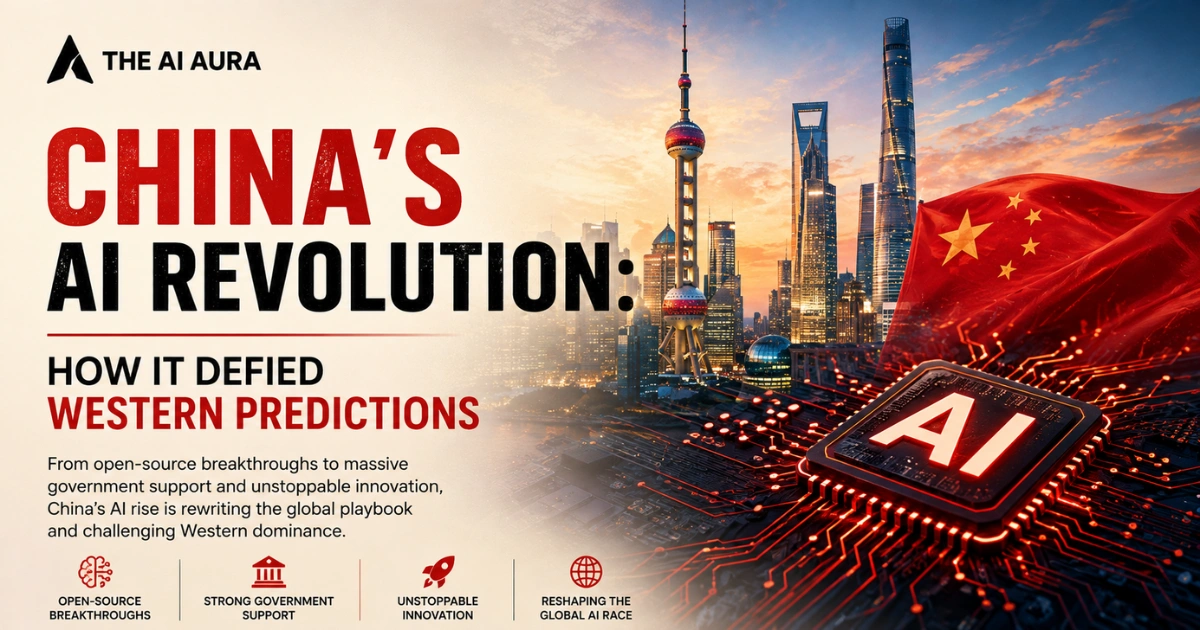

For decades, Western consensus clung to a comforting dogma: China could assemble iPhones and stamped plastics, but it could never pioneer frontier technology.
The orthodox view argued that state intervention, bureaucratic rigidities, and political controls would inevitably stifle the messy experimentation required for true technological breakthroughs.
Every few years, prominent commentators predicted the imminent collapse of the Chinese economic miracle under mountains of municipal debt, demographic decay, or real estate contraction.
Yet China’s industrial trajectory refused to follow the script. The first phase captured global assembly lines through raw scale and low labor costs.
The second phase systematically dismantled foreign dominance in high-complexity manufacturing, from lithium batteries and electric vehicles to precision machine tools.
Now, the transition into what economists call “China 3.0” is unfolding across the artificial intelligence sector, dismantling the assumption that Western computing dominance was unassailable.
The ‘China 3.0’ Playbook: Parity Through Aggressive Cost Compression
Western analysts long assumed that export restrictions on advanced semiconductors would freeze Chinese AI development in place. That calculation underestimated how domestic labs adapt when capital efficiency becomes an existential necessity.
Instead of chasing multi-billion-dollar clusters simply to demonstrate brute-force scale, Chinese developers focused on software-level optimization, architectural efficiency, and relentless cost compression.
The breakthrough became impossible to ignore with releases like Moonshot’s Kimi K3. The model matched the benchmark performance of top-tier Silicon Valley offerings while remaining essentially free to the end user, sparking demand so extreme that server capacity buckled within forty-eight hours of launch.
This reveals the core of Beijing’s AI strategy: track the technological frontier closely, absorb architectural breakthroughs, and immediately diffuse the capabilities throughout the global economy at zero or near-zero cost.
By treating fundamental AI infrastructure as a public utility rather than an exclusive enterprise product, China is bypassing Western distribution bottlenecks and establishing international software standards across developing and non-aligned markets.
It is the exact same playbook that gutted European solar manufacturing and transformed the global automotive sector, applied directly to algorithmic intelligence.
Why Silicon Valley’s Monetization Math Is Breaking Down
This rapid democratization of capable models exposes a structural vulnerability at the center of the American tech rally.
Over the past three years, Western equity markets have poured unprecedented capital into frontier AI, assuming that a small handful of American giants would hold a durable monopoly and command astronomical subscription margins in the shift toward AI-as-a-Service.
That financial thesis rapidly falls apart if Chinese engineering offers comparable reasoning and multimodal capabilities for nothing. When enterprise-grade intelligence becomes a cheap commodity, justifying trillion-dollar infrastructure builds and sky-high price-to-earnings multiples becomes nearly impossible.
Washington’s impulse to respond with punitive trade tariffs and isolationist measures does little to solve this pricing dilemma abroad; global businesses outside the US will simply build atop the cheapest, most accessible foundation available to power their AI strategy.
China’s progress highlights the fundamental difference between speculative financialization and a deliberate, disciplined industrial policy.
While Western economies spent decades neglecting manufacturing capacity and trusting market speculation to allocate resources, Beijing treated technological autonomy as an all-of-government mandate, using targeted subsidies, state-backed compute networks, and regulatory coordination.
The result is an AI landscape where Western developers no longer compete against rival startups, but against a coordinated industrial ecosystem determined to make frontier computing too cheap to monetize.
Source: The Guardian, "China’s Demise Was Gleefully Predicted by the West – Meanwhile, It Built an AI Revolution"