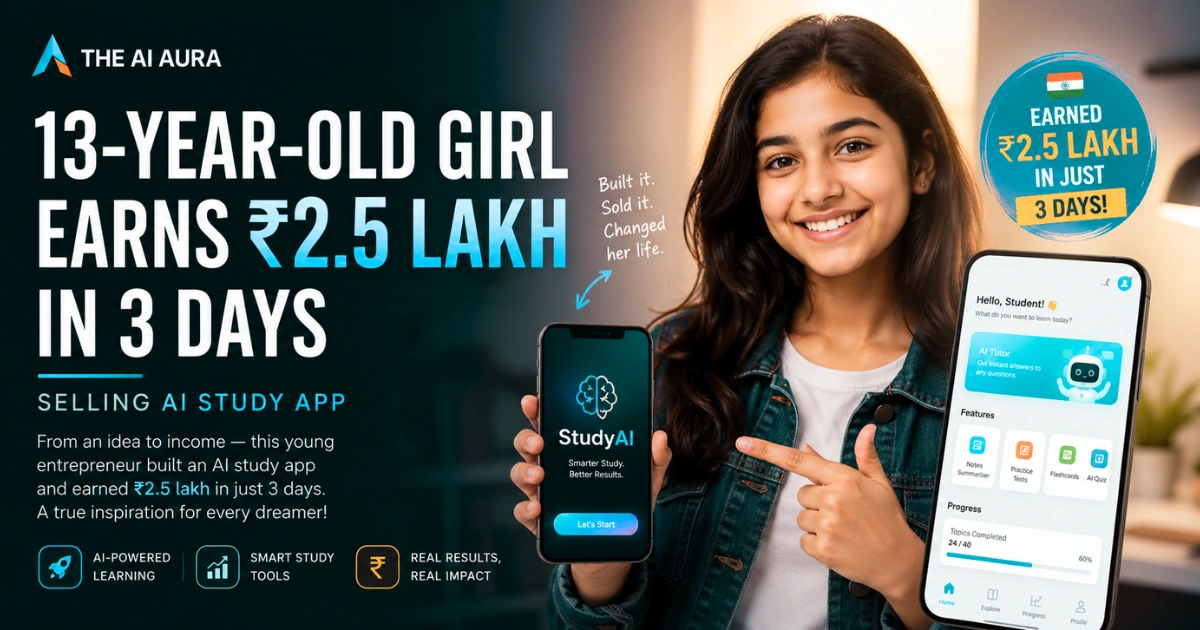

The barrier to entry for building profitable software has officially flatlined. Recently, a 13-year-old girl in China generated 18,000 yuan roughly ₹2.5 lakh in just 72 hours.
Her digital product was straightforward. Specifically, she created an AI-powered tool to monitor and analyze student study habits. In addition, she built the entire project with zero programming experience.
As someone who has closely monitored the technology sector’s evolution from hard-coded server racks to the current generative AI boom, I view this as far more than a viral feel-good story.
It is a glaring indicator of where consumer technology is moving. The traditional prerequisite of a computer science degree to launch a digital product is entirely obsolete. Today, the ultimate currency is problem-solving and prompt engineering.
In fact, solo creators are now moving faster than traditional corporate development teams.
Building Software Without Writing Syntax
The immediate question seasoned developers ask is how a functional, marketable AI application gets built without writing a single line of code. The answer lies in the aggressive maturation of Large Language Models (LLMs) and intuitive no-code deployment platforms.
We have fundamentally transitioned from coding as a manual labor job to coding as a managerial function. A 13-year-old today does not need to understand Python, database architecture, or API routing.
She only needs to know how to articulate a precise command to an AI agent. By leveraging advanced conversational models, creators can simply describe their intended logic in plain English.
The AI generates the underlying code, debugs the syntax errors, and integrates it into a visual builder. Tools in the current ecosystem allow users to drag-and-drop interface elements while the AI handles the complex backend architecture in the shadows.
Her role was effectively that of a high-level product manager. She identified the user journey, instructed the AI to build the framework, and iteratively tested the output until the application functioned as intended. The “tech stack” is no longer a technical hurdle to clear; it is merely an on-demand utility.
Monetizing Parental Anxiety and Niche Utility
Building an app is only half the equation; getting consumers to actually pay for it is where most indie developers fail.
The brilliance of this teenager’s project is not just found in her AI implementation, but in her razor-sharp market positioning. She targeted one of the most reliable buyer demographics on the planet: anxious parents willing to spend money to ensure their children’s academic success.
An AI app that “monitors study habits” strikes a very specific psychological nerve. Parents in highly competitive educational cultures are constantly seeking leverage to keep their kids focused. Instead of marketing a broad, generic AI chatbot, she packaged the artificial intelligence into a hyper-specific utility.
The app likely uses basic generative AI to ingest raw data on study times, suggest schedule optimizations, or flag patterns of procrastination, translating mundane metrics into actionable insights for the parents.
This hyper-niche targeting allowed her to bypass crowded app store algorithms and sell directly to a desperate audience.
Generating ₹2.5 lakh in three days requires incredibly high conversion rates, which only happens when a product solves an immediate, painful problem for the buyer.
It proves that in the modern digital economy, domain expertise and a deep understanding of human psychology will yield far higher financial returns than raw technical proficiency ever could.
Source: Moneycontrol, "13-Year-Old Girl with No Coding Skills Earns Rs 2.5 Lakh in 3 Days Selling AI Study App"