
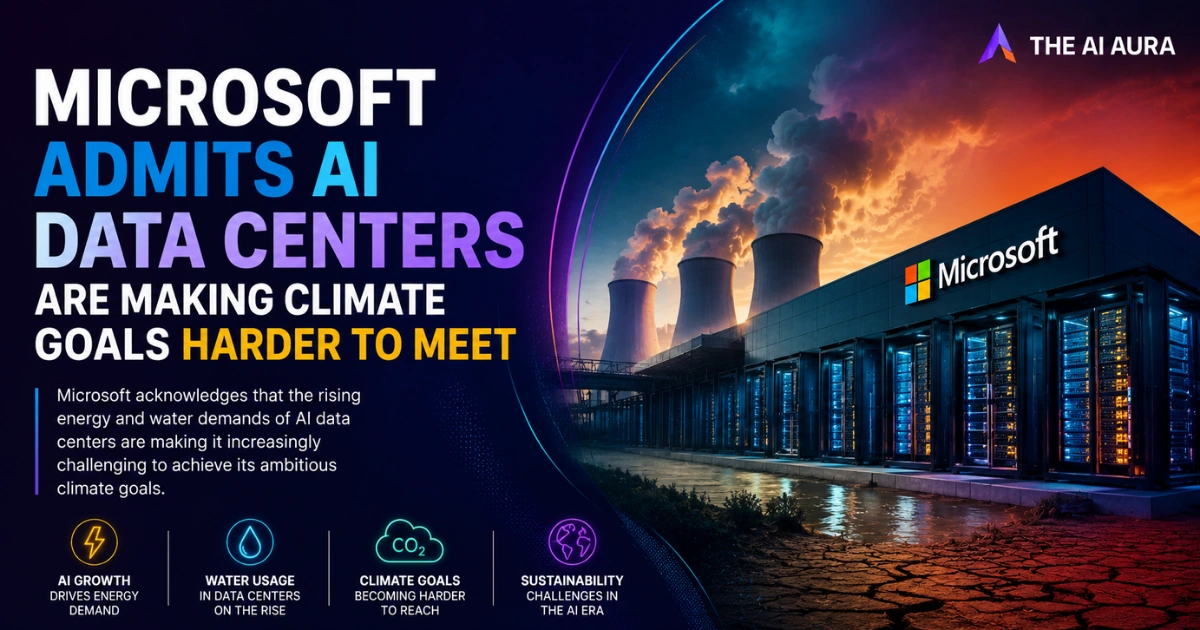

A few years ago, Microsoft set the gold standard for corporate environmental responsibility by pledging to become carbon negative by 2030. It was an aggressive, celebrated milestone.
But that commitment was made in a pre-ChatGPT world. Today, the generative AI arms race has fundamentally altered the math, forcing the tech giant into a difficult public and internal reckoning.
According to recent internal communications, Microsoft leadership is openly acknowledging a harsh reality: building the physical infrastructure required to power advanced artificial intelligence is severely derailing their climate targets.
Noelle Walsh, the head of Cloud Operations and Innovation, recently had to address growing anxiety among Microsoft’s own workforce regarding the surging power, water, and carbon demands of their sprawling server campuses.
This is no longer just a theoretical debate about sustainability; it is a structural collision between the company’s technological ambitions and the physical limits of the environment.
The Raw Mechanics of AI Power Consumption
To understand why Microsoft’s emissions are climbing instead of falling, you have to look at the underlying physics of how artificial intelligence actually works.
Traditional cloud computingvhosting websites, managing databases, running email servers operates on standard processors that are relatively energy efficient. Generative AI, however, requires a completely different scale of brute force.
Training large language models relies on massive clusters of highly specialized GPUs running in parallel for months at a time.
A single modern AI chip draws an immense amount of electricity under peak load. When you stack tens of thousands of these chips into a hyper-scale facility, the power draw immediately rivals that of small cities.
Electricity is only half the problem. Generating that much localized computational power produces an extraordinary amount of heat. To keep these server racks from literally melting down, facilities must pump millions of gallons of water through sophisticated cooling systems.
Furthermore, because local power grids rarely run entirely on wind or solar, the sudden, massive electricity draw forces regional utility companies to rely on natural gas or coal to keep the lights on. The AI might live in the cloud, but its footprint is aggressively industrial.
Balancing Innovation with Local Resistance
The environmental cost of AI is sparking deep unease within Microsoft’s own ranks, mirroring a broader wave of external pushback.
Walsh’s internal memo urged employees to view these data centers as necessary engines for future problem-solving, promising that the infrastructure is being built with transparency and a focus on minimizing community impact.
However, local realities are making that narrative difficult to sustain. Neighborhoods positioned near these massive server campuses are facing strained municipal water supplies, new high-voltage transmission lines cutting through their towns, and the persistent, droning hum of industrial cooling fans.
Industry tracking groups like Data Center Watch note that fierce community resistance is rapidly becoming a major bottleneck for new computing projects across the country.
Microsoft is currently attempting a delicate tightrope walk. Leadership is trying to convince a skeptical workforce and an increasingly frustrated public that the long-term societal benefits of artificial intelligence will eventually outweigh the heavy toll exacted on the physical environment today.
Yet, as greenhouse gas metrics climb and communities continue to protest, the gap between corporate climate promises and the reality of AI expansion has never been wider.
Source: The Times of India, "Microsoft Sends Memo to Employees on Data Centers; Admits AI Making It Tough to Meet Some Prior Environmental Commitments"