

Meta dominates the tech landscape today with Facebook, Instagram, and WhatsApp. You might assume the company runs like a well-oiled machine. However, the reality behind closed doors tells a different story.
Over the past few years, the tech giant aggressively trimmed its workforce. Leadership called this shift a push for corporate efficiency.
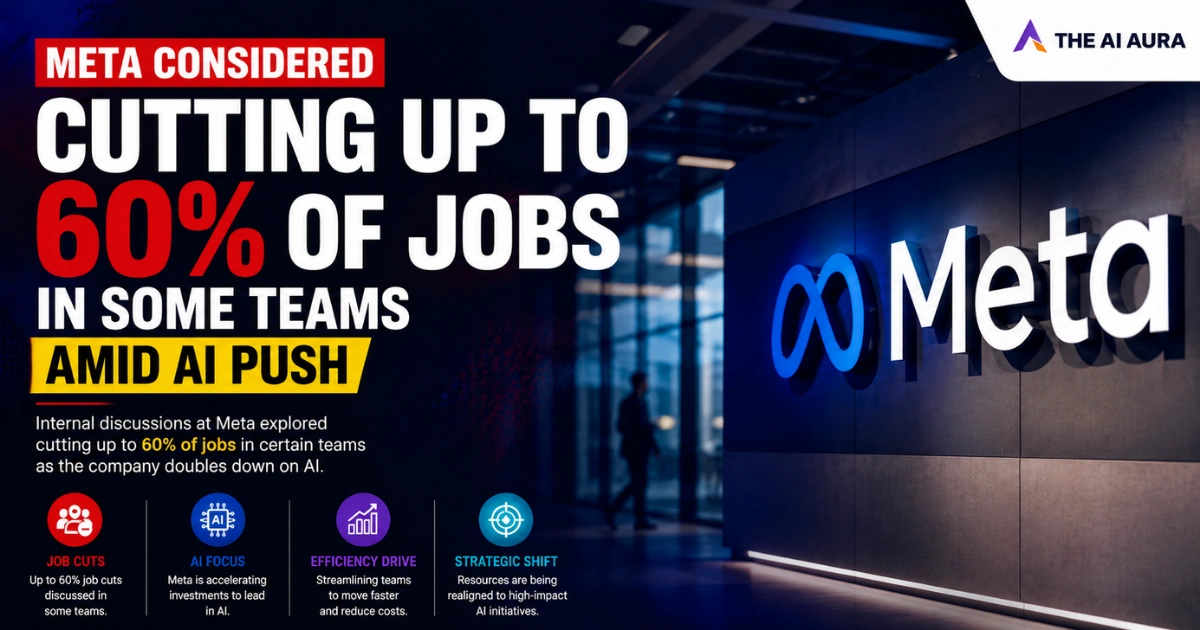
Recent leaks reveal how far Mark Zuckerberg wanted to go. Internal discussions showed a shocking plan. Meta actively considered cutting up to 60% of jobs in specific teams to deploy AI.
Over the last couple of years, the tech giant has been aggressively trimming its human workforce, prioritizing what leadership has famously dubbed a new era of corporate efficiency. But recent leaks have pulled back the curtain on just how far CEO Mark Zuckerberg was willing to go.
As someone who has tracked corporate restructuring and tech scaling for years, I find the mechanics of this proposed layoff fascinating. It wasn’t just a traditional cost-cutting measure; it was a calculated attempt to rapidly swap human labor for automated AI models.
Yet, the most compelling part of this story isn’t the scale of the proposed cuts, but rather the unexpected voice of reason that ultimately stopped them.
When AI Itself Pulls the Emergency Brake
Meta’s internal documents outlined two waves of deep cuts for May and November. This drastic 60% figure was never a company-wide purge. Instead, leaders targeted specific departments. They believed generative AI could immediately absorb these workloads.
Before making the cuts, Meta asked its own AI models to evaluate the restructuring plan. The outcome was deeply ironic. The very technology meant to replace workers ended up protecting them.
The internal AI analysis issued a stark warning to executives. It predicted intense employee resistance and severe operational risks. Removing human oversight too quickly could destabilize vital platform feedback loops.
Reportedly, this automated risk assessment convinced Zuckerberg to drop the extreme 60% target.
The Limits of the Silicon Valley Automation Dream
This situation at Meta serves as a crucial reality check for the broader tech industry. We are currently in an environment where executives view AI models primarily as a payroll-saving mechanism.
Replacing a massive department with a highly efficient algorithmic model looks brilliant on a financial spreadsheet but executing that transition in a live operational environment is vastly more complicated.
The fact that an artificial intelligence system had to warn a tech billionaire about the practical limits of automation highlights a significant blind spot in modern tech leadership.
You simply cannot rip out the foundational human infrastructure of a company serving billions of users without inviting chaos. The teams in the crosshairs for these cuts were likely managing nuanced, highly contextual tasks.
Whether it involves complex algorithmic safety protocols, content moderation, or intricate platform engineering, AI still lacks the contextual reasoning required to operate entirely independently at that scale.
Meta’s internal models recognized a fundamental operational truth: human workers are not merely a replaceable expense. They are the essential safety net that prevents minor technical anomalies from snowballing into catastrophic platform outages.
While the aggressive push for AI integration will inevitably continue across the tech landscape, this incident proves that we are still a long way from the purely automated corporate utopia that some executives are eager to build.
Source: Gulte, "Meta Wanted To Slash 60% Jobs, But AI Spoiled The Plan?"