
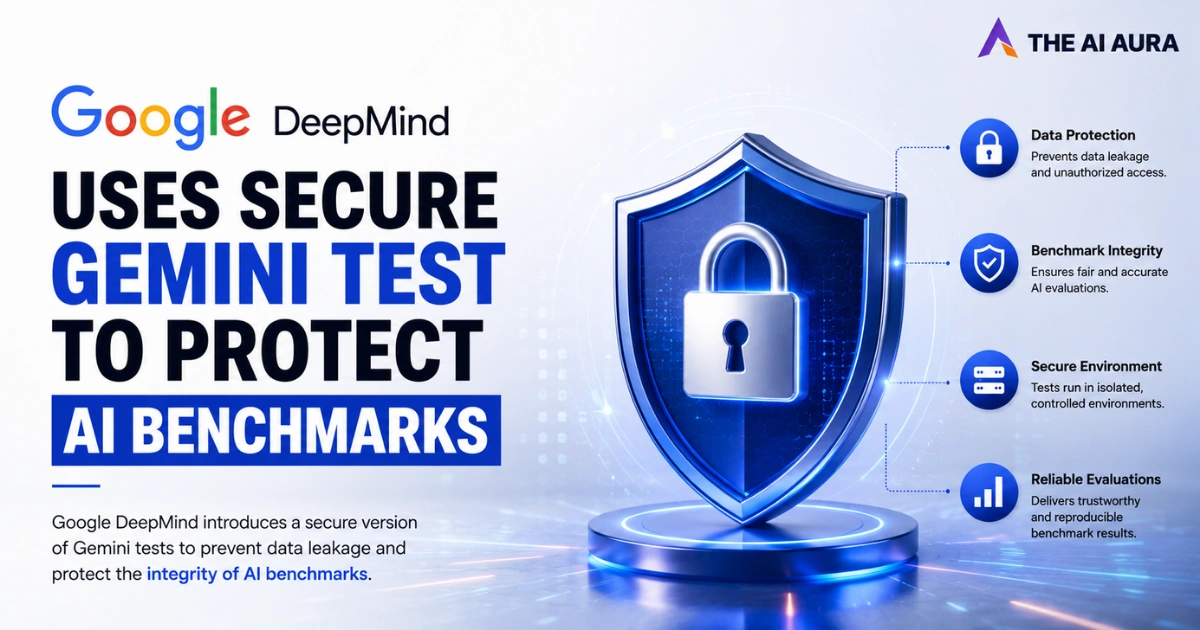

The artificial intelligence industry shares an open secret about testing: models often hold the answers before exams begin. Engineers call this benchmark contamination.
When a frontier model aces a complex safety test, evaluators cannot tell if it shows genuine intelligence or simply repeats ingested training data.
Google DeepMind is attempting to eliminate this uncertainty. Recently, the company piloted what it calls the first double-blind evaluation of a proprietary frontier model.
By placing its Gemini 2.5 Flash Lite model behind a cryptographic wall, DeepMind aims to prove that an AI can be rigorously tested without exposing the model’s proprietary architecture or the evaluator’s secret questions.
DeepMind collaborated with OpenMined, AVERI, MLCommons, and the Singapore AI Safety Institute. The team tested Gemini against cyberattacks, chemical hazards, and dangerous prompts. Crucially, neither side viewed the other’s intellectual property.
How the Double-Blind Cryptographic Wall Actually Works
Historically, third-party AI testing has been paralyzed by a massive standoff. Independent evaluators are terrified of handing over their premium test prompts to tech giants, knowing those prompts might accidentally be absorbed into future training runs.
Conversely, AI developers refuse to hand over their proprietary model weights to external testers, protecting their multibillion-dollar intellectual property.
DeepMind’s solution is a cryptographically secured digital neutral ground. The system operates on Google Cloud A3 Confidential VMs, utilizing Intel TDX host-memory encryption alongside NVIDIA H100 Confidential GPUs.
In practice, this hardware configuration creates an isolated, encrypted enclave. The evaluator pushes their secret test prompts into this environment, and Google pushes the Gemini model weights in as well.
Inside this secure space, the evaluation runs its course. Google cannot peek at the benchmark prompts, and the evaluating bodies cannot access the underlying model weights. Through remote attestation and hardware-level encryption, the software environment is mathematically verified to remain secure from both sides.
This infrastructure specifically allowed AVERI to run MLCommons’ AILuminate safety benchmark, while the Singapore AI Safety Institute independently tested Gemini against hyper-localized harmful content parameters.
It completely sidesteps the traditional reliance on zero-logging policies and flimsy contractual promises, replacing legal trust with cryptographic proof.
Unanswered Questions and the Reality of AI Testing
While the architecture represents a brilliant leap forward for benchmark integrity, this pilot leaves a rather massive question dangling: we have absolutely no idea how Gemini 2.5 Flash Lite actually performed.
DeepMind published an exhaustive technical report on the double-blind methodology but deliberately withheld the model’s scores and task-by-task breakdowns.
From an engineering perspective, there are also a few lingering caveats. The technical report admits that some of Google’s proprietary inference code could not be fully inspected.
More importantly, Google services were used to sign and verify the attestation reports. When the model provider is actively in the verification path, the system isn’t entirely trustless.
For IT leaders, regulators, and enterprise buyers, this experiment is still a vital signal of where the industry is heading. As AI integrates deeper into critical infrastructure, benchmark scores will drive regulatory decisions and massive enterprise contracts.
A secure, double-blind evaluation process means we might soon have independent proof that a model is safe against biological hazards or cyber threats without relying on the developer’s word.
For this to become a genuine industry standard, however, the secrecy needs to fade. Cryptographic walls are only as valuable as the transparency of the results they produce.
Until this methodology becomes independently reproducible and actual performance metrics are published alongside the security specs, we merely have a better testing facility, not necessarily a more trustworthy AI.
Source: TechRepublic, "Google DeepMind Seals Gemini Test to Protect AI Benchmarks"