
For years, Silicon Valley dominated the artificial intelligence boom. Now, a Bangalore-based startup is changing the narrative. They prove that AI disruption requires smart engineering and smart economics.
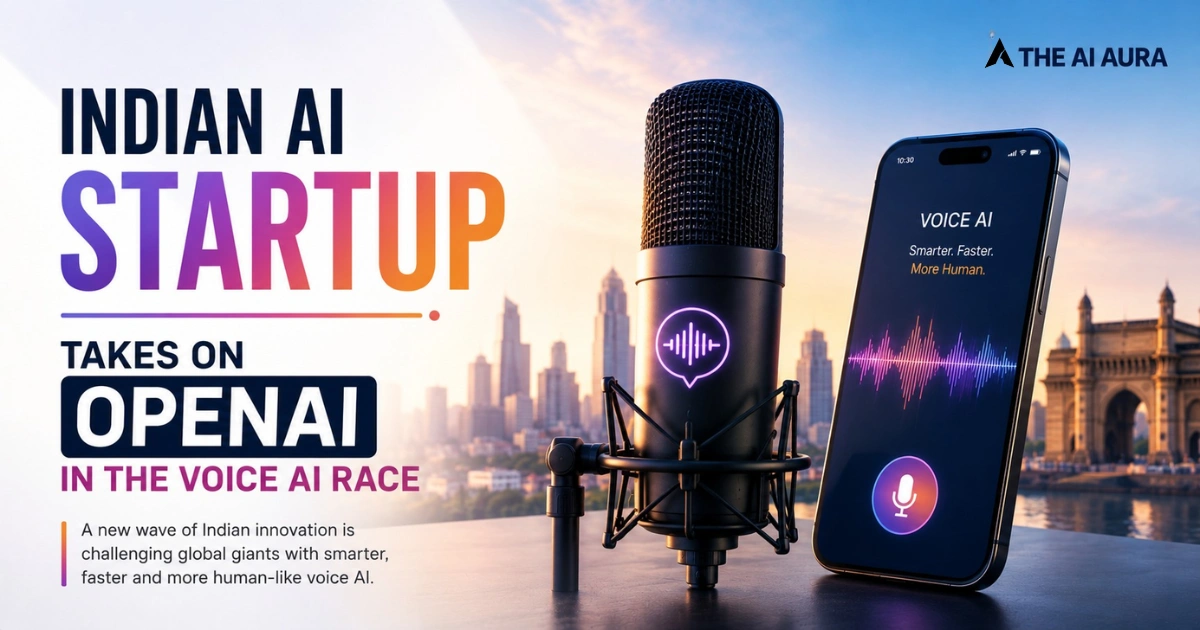
Murf AI has officially entered the competitive synthetic voice arena. They recently launched Falcon 2, a new text-to-speech foundation model. This model directly challenges industry giants like OpenAI and ElevenLabs.
Founded in 2020 by IIT Kharagpur alumni Sneha Roy, Ankur Edkie, and Divyanshu Pandey, Murf is not a weekend experiment.
Backed by Elevation Capital and Matrix Partners, they are already serving heavy-hitting corporate clients like Cisco, Pfizer, and Nestlé.
With Falcon 2, they target high-volume sectors like call centers, airlines, and banks. In these sectors, success demands low latency, high audio quality, and strict cost efficiency.
Breaking the Silicon Valley Monopoly on Quality
If you track the voice generation space, you know the barrier to entry isn’t just generating sound; it’s replicating the nuanced cadence of human emotion. Falcon 2 recently topped several metrics on the independent Artificial Analysis leaderboard, outperforming well-funded competitors including OpenAI’s own Realtime API.
The secret to this performance lies in how Murf AI approached its training pipeline. Instead of relying purely on scripted, static narrations, Falcon 2 was trained on real-world, high-friction conversational data live customer service disputes and complex booking workflows.
The model actively interprets the semantic weight of a sentence, dynamically adjusting its pace, emphasis, and pronunciation based on context. It even tackles the perennial Achilles’ heel of voice AI: the accurate, natural-sounding delivery of alphanumeric strings, localized currencies, and convoluted addresses.
Clocking in with a response time of under 100 milliseconds, the model essentially eliminates the awkward lag that usually betrays an automated agent. Furthermore, Murf is addressing the industry’s growing copyright backlash head-on.
The startup explicitly contracts real voice actors, guaranteeing ongoing royalties, transparent data protection, and explicit consent for their 150-plus voices across 35 languages. This ethical sourcing is rapidly becoming a hard requirement for enterprises terrified of future intellectual property lawsuits.
Enterprise Economics at the Core
Where this race is actually going to be won isn’t just in the engineering lab; it’s on the balance sheet. Falcon 2 is priced aggressively at $0.01 per generated minute, a move that fundamentally upends the current pricing structures of the voice AI market.
To put this into perspective, scaling a conversational AI agent for a major airline or global bank requires millions of minutes of generated speech every month. Processing one million minutes through Falcon 2 costs a company roughly $10,000.
Running that exact same volume through a leading competitor like ElevenLabs’ Turbo or Flash models would set a company back close to $50,000. That massive 80% cost reduction is exactly what makes Murf’s offering so dangerous to the established players.
Murf designed Falcon 2 for heavy enterprise workloads. The platform easily handles 10,000 concurrent calls without performance drops. Murf also meets strict compliance rules with data residency across 11 regions. Companies can even deploy the model in private cloud environments.
Western AI labs often charge premium prices for high-quality audio. Murf delivers top-tier performance at a fraction of the cost, forcing rivals to adapt.
Source: Official Bloomberg, "India Startup Aims to Compete With OpenAI in Crowded Voice Arena"