
For years, I’ve tracked the exponential growth of natural language processing. We dictate emails to our phones, generate text instantly, and get real-time translations of spoken foreign languages with almost flawless accuracy.
Yet, the tech industry has historically sidelined a critical demographic: the estimated 70 million Deaf and hard-of-hearing individuals worldwide who rely on sign languages.
The problem was never a lack of need. It was a fundamental misunderstanding of the complexity involved. Sign languages aren’t simply spoken languages mimed with the hands.
They are independent, structurally distinct languages with unique grammar, syntax, and spatial parameters.
Today, we are witnessing a genuine paradigm shift with the introduction of a massively multilingual sign-language-to-text (SL2T) translation model.
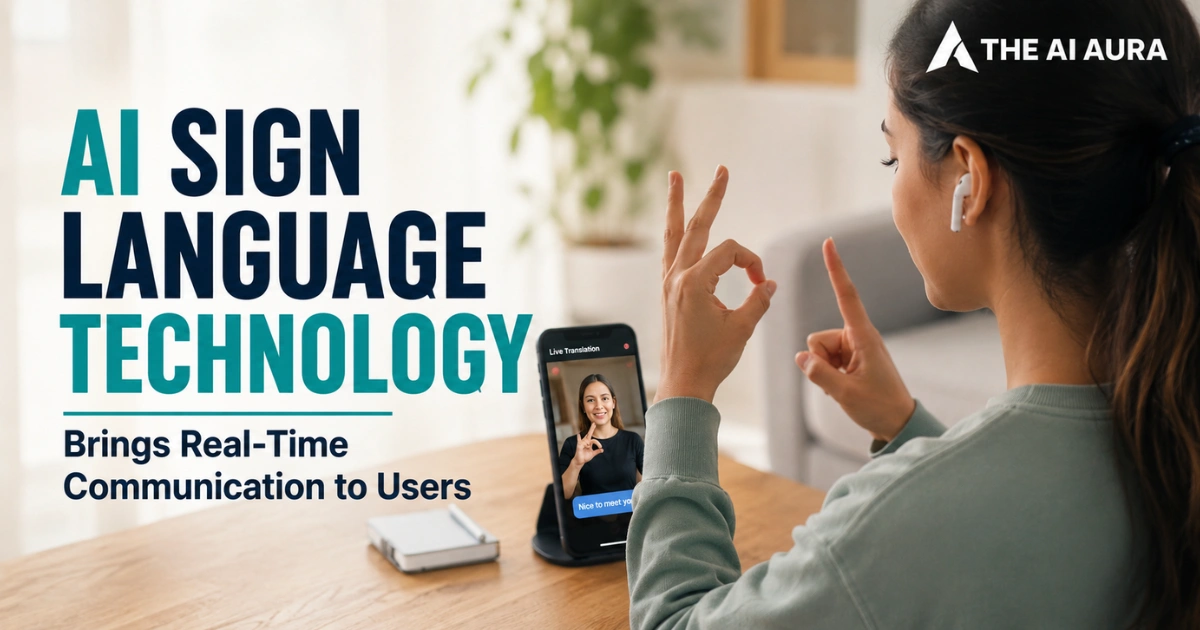
Launching first on the Pixel 11 via Gboard and Live Transcribe, this technology finally pulls sign language AI out of controlled laboratory environments and integrates it into daily consumer use, starting with American Sign Language (ASL).
The Mechanics of Visual Language Processing
Early attempts at bridging this accessibility gap were frustratingly limited. For example, hardware experiments like “smart gloves” failed because they misunderstood the medium.
They treated signing as a sequential word-for-word translation. However, sign language conveys meaning simultaneously. It relies on hand shapes, arm movements, torso shifts, and facial expressions.
To solve this challenge, modern SL2T models combine user-centric data with massive computational scale. Developers trained the system on over 100,000 hours of video across 50 sign languages.
As a result, the neural network learns shared linguistic structures instead of treating each language in isolation. In addition, diverse datasets teach the AI to recognize regional dialects, varying skill levels, and one-handed smartphone signing.
Crucially, this system bypasses outdated intermediate steps. In the past, developers relied on written annotations known as “glosses.” However, this old method stripped away rich spatial and emotional context.
By translating geometric coordinate sequences directly into text, the current architecture removes artificial limits. Consequently, the system delivers fluid, zero-shot translation. It adapts to real-world human communication instead of forcing users to adapt to machines.
Privacy, Accessibility, and Community-Driven Design
From a security standpoint, streaming continuous camera footage to cloud servers creates major privacy risks. The SL2T architecture solves this problem through on device pose tracking.
Using tools like MediaPipe Holistic, the device identifies geometric landmarks on the signer’s body. The app sends only abstract spatial coordinates to the translation server and discards the raw video immediately. Therefore, users get powerful cloud translation without compromising their visual privacy.
But the technical architecture is only half the story. The success of this rollout hinges entirely on participatory design.
Built alongside the Deaf community spearheaded by Deaf developers and guided by the global AI Sign Language Advisory Committee (AISLAC) the tool reflects actual user habits rather than top-down assumptions.
It addresses highly practical friction points, such as minimizing streaming latency for real-time Live Transcribe conversations and ensuring the model doesn’t hallucinate text when a user is simply moving their hands naturally.
Integrating this feature directly into mobile keyboards helps Deaf individuals dictate messages, search the web, and interact with AI assistants seamlessly. Ultimately, this is a vital step toward digital inclusion, proving that technology bridges gaps when research aligns with lived community experience.
Source: Official Google DeepMind, "Putting Sign Language AI Into Users’ Hands"