
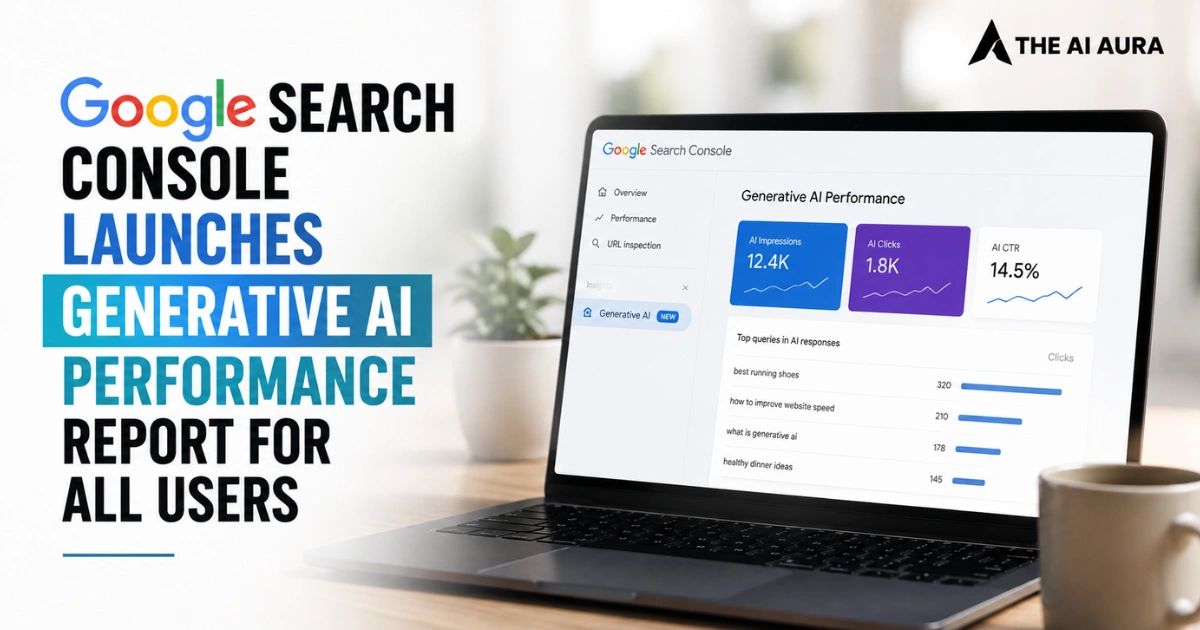

Log into Google Search Console and you may notice a new change in the Performance report. Google has expanded access to its Generative AI Performance report after a period of testing.
The rollout is not identical for every website, however. Some sites already have access, while others may not see the report yet.
Google has also clarified that the feature depends on whether a website generates enough data from AI Overviews. Sites with limited AI visibility may need to wait until they reach the required threshold
What the New Generative AI Data Actually Reveals (and Hides)
For webmasters who have cleared the data threshold, the interface offers a fascinating, albeit restricted, look under the hood of modern search visibility.
The dashboard shows how often your URLs appear in generative AI features. It also tracks impressions across Google Search and Discover.
You can filter the data by country and device type. You can also compare daily and hourly performance. This makes it easier to see where your content gains AI search visibility.
The excitement abruptly stops when you look for actionable engagement metrics. The most critical data points for any search marketer clicks and specific user queries are entirely absent from this release.
We can definitively see that a page appeared in an AI overview, but we have absolutely no mathematical way of knowing if that appearance drove a single human visitor to the actual website.
Furthermore, without query data, reverse-engineering the exact user questions that triggered your content requires a heavy dose of guesswork. You know your text is being referenced by the AI, but you remain completely blind to the conversational prompts that pulled you into the spotlight.
Strategic Shifts for Publishers Going Forward
Despite the glaring lack of click-through data, having access to impression metrics fundamentally changes how we measure top-of-funnel content reach.
For years, publishing strategy has been strictly focused on securing the ten blue links. Now, identifying which of your pages secure the highest generative AI impressions allows you to audit those specific URLs for common structural traits.
By analyzing the specific pages Google’s AI currently favors, you can adjust your editorial strategy to match those formats across underperforming articles.
Take a close look at your URLs earning high AI impressions. Are they structured as direct, authoritative Q&As? Do they leverage original research that satisfies strict experience and expertise signals? You have to treat these AI impressions as high-value brand visibility.
Even without explicit click data, a massive impression volume indicates that Google trusts your domain enough to feed it directly into its foundational models for user answers.
Your immediate operational goal should be to monitor this new dashboard, identify your top AI-referenced URLs, and aggressively replicate the formatting, depth, and clarity of those pages across your broader site architecture.
Source: Official Search Engine Roundtable, "Google Search Console Generative AI Performance Report Expands To More"