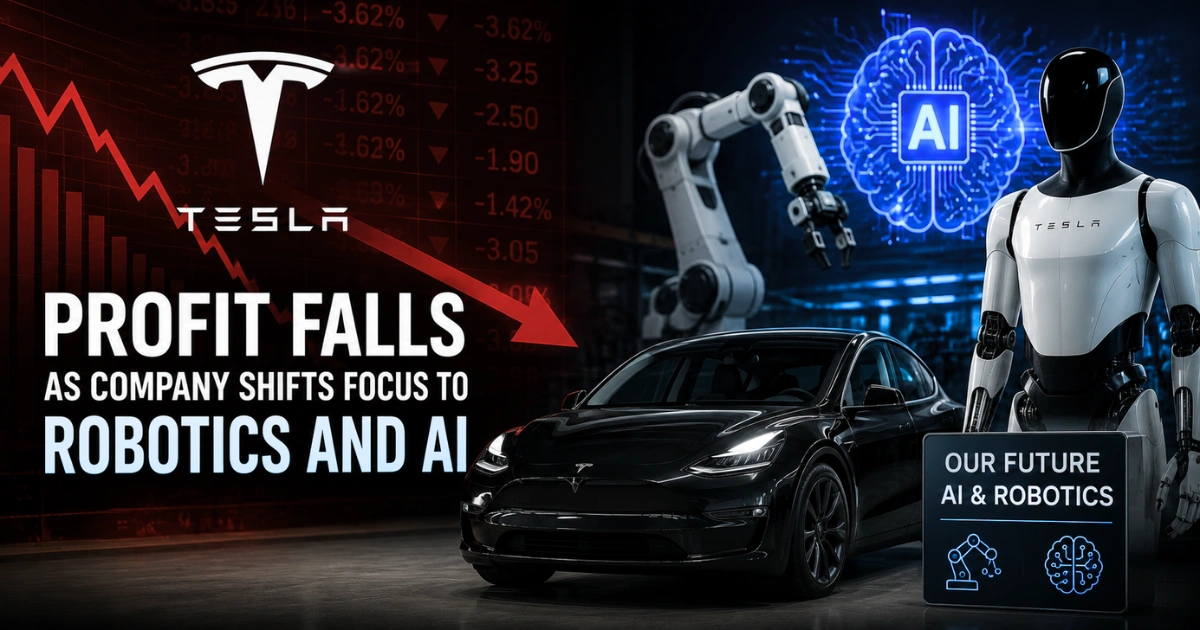

Tesla’s latest quarterly results highlight a company in the middle of one of the biggest strategic shifts in its history. While electric vehicles remain its primary business, CEO Elon Musk is increasingly positioning Tesla as an artificial intelligence and robotics company.
That transformation is reshaping investor expectations, even as it creates short-term financial pressure.
In the second quarter, Tesla reported earnings of 31 cents per share, missing analysts’ expectations of 51 cents.
Although quarterly revenue reached $28.23 billion, surpassing forecasts, weaker profitability weighed on investor sentiment, sending the company’s shares lower in after-hours trading.
The earnings report reflects a broader reality: Tesla is investing heavily in technologies that may define its future, but those investments are taking time to generate meaningful returns.
AI and Robotics Are Becoming Tesla’s Core Growth Strategy
Tesla’s long-term vision now extends well beyond manufacturing electric vehicles.
A major part of that strategy is Robotaxi, the company’s autonomous ride-hailing platform.
Rather than earning revenue solely from vehicle sales, Tesla hopes to generate recurring income through self-driving transportation services powered by its Full Self-Driving technology.
The company has expanded Robotaxi testing into several U.S. cities, including Austin, Tampa, Orlando, Dallas, Houston, and Miami. However, deployments remain relatively limited as Tesla continues refining the technology while navigating safety regulations and public trust.
Autonomous driving presents enormous opportunities, but scaling the service requires consistent real-world performance and regulatory approval. Any major safety incident could significantly slow adoption, making careful expansion essential.
Tesla is also investing heavily in Optimus, its humanoid robot designed to automate repetitive physical tasks across factories, warehouses, and eventually homes. Musk believes robotics could become an even larger business than electric vehicles over the long term.
Despite the ambitious vision, Optimus remains in the early stages of commercialization.
Developing robots capable of safely operating in complex real-world environments requires advances in artificial intelligence, computer vision, sensors, and mechanical engineering.
At the same time, competition from Chinese robotics companies continues to intensify, increasing pressure on Tesla to accelerate development.
Vehicle Business Faces Growing Global Challenges
While Tesla invests in future technologies, its traditional automotive business is encountering several headwinds.
The gradual reduction of electric vehicle incentives in key markets has affected consumer demand, while aggressive pricing from Chinese EV manufacturers has increased competition worldwide. To remain competitive, Tesla has repeatedly adjusted vehicle prices, placing additional pressure on profit margins.
Despite these challenges, demand in several European markets has remained relatively resilient, supported by continued government incentives and growing consumer interest in electric transportation.
Investors are also becoming more cautious about companies making large, long-term AI investments without immediate financial returns.
Tesla’s strategy requires billions of dollars in research, infrastructure, computing resources, and manufacturing capacity before businesses like Robotaxi and Optimus can contribute meaningfully to earnings.
This transition helps explain why revenue can continue growing while profits decline. Tesla is prioritizing long-term innovation over maximizing short-term margins, a strategy that often creates volatility in quarterly results.
The company still benefits from strong brand recognition, industry-leading battery technology, and one of the world’s largest connected vehicle fleets, providing valuable data to improve its AI systems.
However, the next phase of Tesla’s growth will depend less on how many cars it sells and more on how successfully it commercializes autonomous driving and robotics.
For investors, the latest earnings underscore that Tesla is no longer being valued solely as an automaker. Its future increasingly depends on whether its AI-powered technologies can evolve from ambitious prototypes into profitable businesses.
The company’s financial performance may remain uneven during that transition, but its long-term strategy is becoming increasingly clear: build an ecosystem where artificial intelligence powers both transportation and automation.
Source: The Guardian, "Tesla Profits Slide Despite Growing Revenue as It Pivots to Robotics and AI"