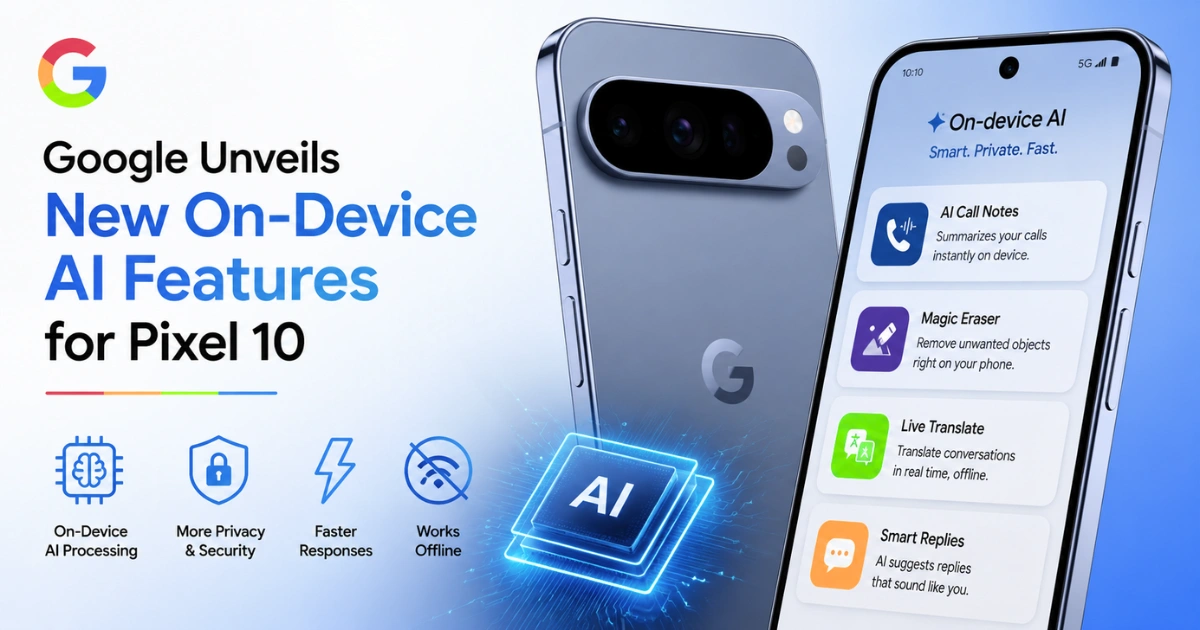

Google is bringing more artificial intelligence directly onto smartphones with the Pixel 10, reducing the need to rely on cloud processing for everyday AI tasks. The company’s latest on-device AI features focus on three key advantages: stronger privacy, faster response times, and the ability to work without an internet connection.
Unlike cloud-based AI, which sends user data to remote servers for processing, on-device AI performs tasks locally using the phone’s hardware.
That approach keeps sensitive information on the device while reducing latency and allowing AI features to continue working in offline environments.
The Pixel 10 uses Google’s dedicated Tensor Processing Unit (TPU) to power these experiences, marking another step in the company’s long-term strategy to make smartphones more capable without constant cloud connectivity.
New AI Models Bring Faster and More Private Experiences
At Google I/O India, the company introduced Gemma 4 E2B, a lightweight AI model designed specifically for the Pixel 10’s custom TPU.
Because the model runs entirely on the device, personal information such as messages, photos, and voice commands no longer needs to leave the phone for many AI tasks.
Google demonstrated several offline capabilities during the event. Users can generate travel plans, organize recipes, manage smart home devices, and perform other AI-powered tasks even without an internet connection.
The company also showcased Function Gemma and Mobile Actions, which allow users to control phone settings through natural language.
Simple voice commands can switch Wi-Fi on or off, launch navigation in Google Maps, or perform other device actions almost instantly.
By processing AI requests locally, Google aims to improve both privacy and responsiveness while reducing dependence on cloud infrastructure.
Offline Multimodal AI Expands Pixel 10’s Capabilities
Google also introduced what it calls Rich Offline Multimodal Interactions, allowing the Pixel 10 to understand text, images, and audio without connecting to the internet.
During demonstrations, the device answered complex questions in airplane mode, identified plants and objects through the camera, and transcribed lengthy lectures entirely on the phone.
Google also highlighted practical use cases across different industries. In retail, shoppers can generate shopping lists and receive in-store navigation without relying on mobile data. In automotive repair, mechanics can photograph vehicle components and receive AI-assisted diagnostics directly on the device.
The Pixel 10 builds on Google’s long-standing focus on practical AI features. Earlier innovations such as Hold for Me showed how on-device intelligence could improve everyday smartphone experiences without requiring constant user attention.
With the latest generation of Pixel devices, Google is extending that philosophy by making more advanced AI capabilities available offline, giving users faster performance while keeping more of their personal data on their own devices.
Source: PhoneArena, "Google Demonstrates New Local Pixel 10 AI Features"