
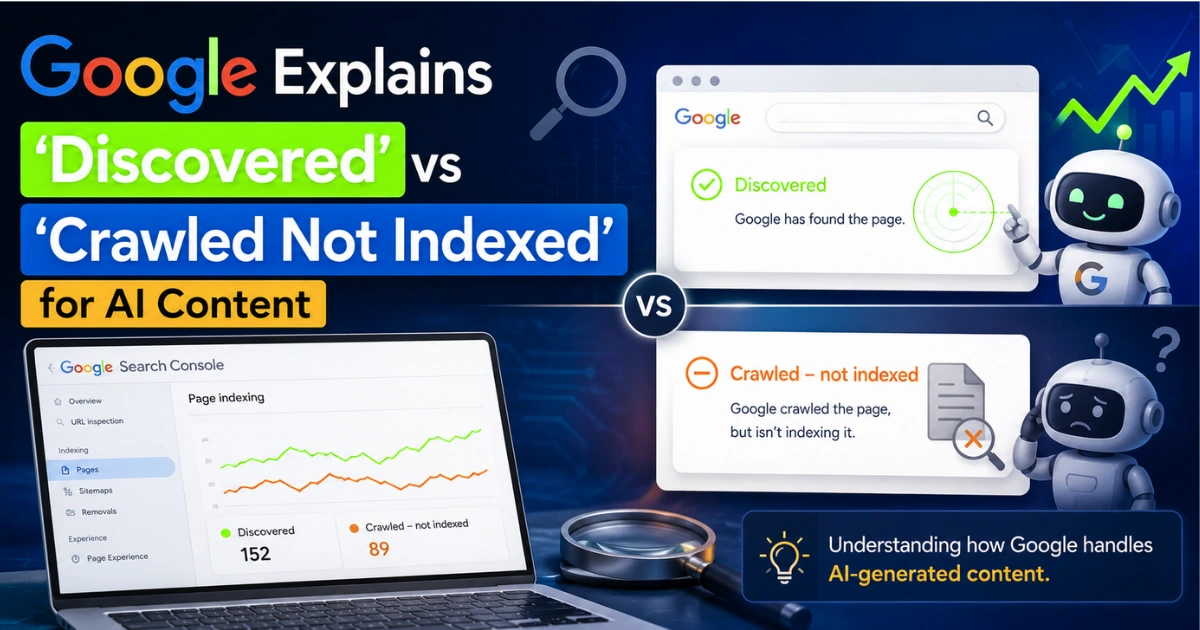

Google’s John Mueller and Martin Splitt used the latest episode of the Search Off the Record podcast to walk through one of the more confusing corners of Search Console: why a page can sit unindexed with no obvious technical problem attached to it.
Mueller’s message is simple: these statuses rarely indicate a technical bug. Instead, Google’s systems often use them to flag quality issues. In many cases, those issues arise because AI-generated content sounds too similar to countless other pages on the web.
The actual difference between the two statuses
The two labels sound similar but describe different moments in Google’s process.
“Discovered, currently not indexed” means Google has found a URL but hasn’t crawled it yet. “Crawled, currently not indexed” indicates a more advanced stage. Google crawled the page, evaluated its content, and decided not to include it in the index.
Splitt asked Mueller whether the second status usually points to a deeper quality problem, and Mueller gave a qualified yes.
When Google’s systems identify concerns about a site’s overall quality, they reduce their crawling and indexing efforts. They crawl fewer pages and index less of the content they evaluate.
Both statuses tell site owners that Google knows the page exists and may review it again later if the site meets its quality standards. They do not indicate a permanent rejection or a misconfigured site setting.
What This Means for AI-Generated Content
Mueller stopped short of declaring AI-generated content automatically disqualifying.
Instead, he made a narrower point that’s, in some ways, harder to act on: when a page reads like something anyone could write and offers nothing unique or genuinely useful to searchers, Google’s systems have little reason to allocate index space to it, regardless of how the creator produced the content.
The problem isn’t the AI origin itself, it’s what that origin often produces at scale, page after page of generic, interchangeable text that adds nothing beyond what a dozen competing pages already say.
Mueller also pushed back on the instinct to treat this as a checklist of technical fixes. Instead, he advised creators to audit their content, a process they can evaluate and optimize with modern AI SEO tools.
He also encouraged them to step back and view their site through the eyes of a first-time visitor, since site owners often become too attached to their own content to recognize when it feels ordinary.
Broader SEO commentary echoes the same practical direction, treating output from AI writing assistants as a first draft rather than a finished page, adding real expertise, specific examples, and an actual point of view before publishing, and pruning or strengthening the weakest pages on a site rather than leaving them to drag down trust in everything else.
The throughline across both statuses is that Google is evaluating patterns across a whole site, not grading individual pages in isolation. A handful of thin pages on an otherwise strong site rarely triggers this.
Google’s systems judge an entire domain by identifying a pattern of generic, AI-assembled content across many pages.
That pattern convinces the crawler to reduce the crawl budget it would otherwise allocate, which explains why technical fixes rarely solve “Crawled – Currently Not Indexed” issues.
They fail because Google’s systems flag the content itself, not the site’s technical setup.
Source: Search Engine Roundtable, "Google: 'Discovered – Currently Not Indexed' vs. 'Crawled – Currently Not Indexed' for AI Content and Site Quality"