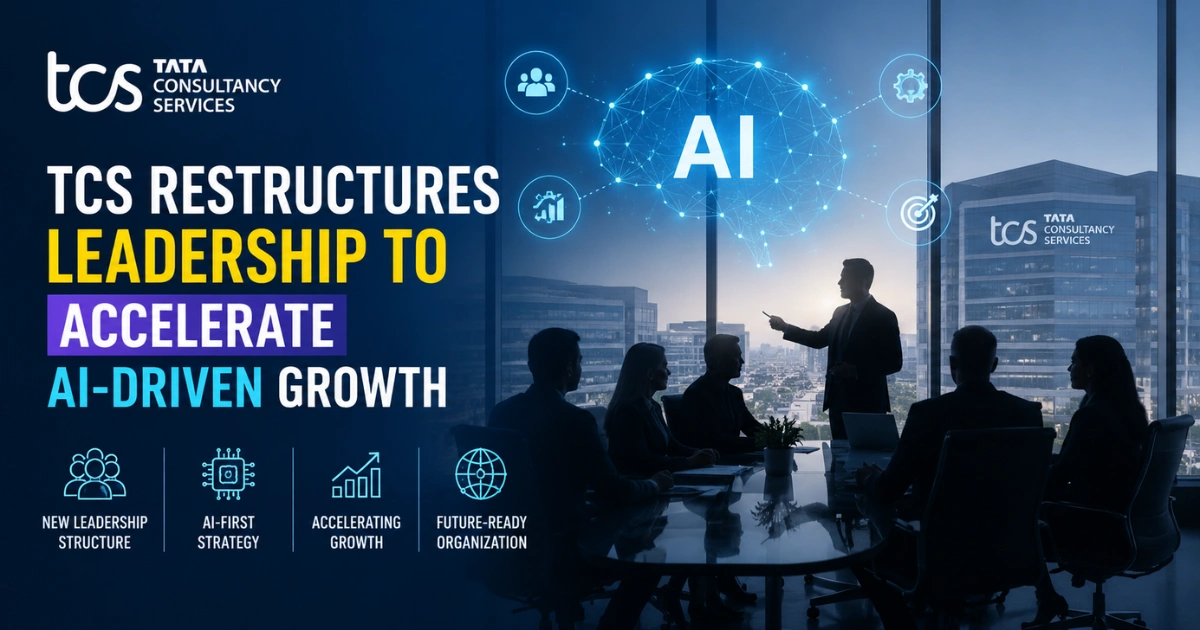

Global enterprise tech demands specialized, high-velocity leadership. Tata Consultancy Services (TCS) recently proved it understands this shifting dynamic by executing its most substantial leadership and operational reshuffle in three years.
According to internal communiqués, the restructuring slices through massive revenue engines like Banking, Financial Services, and Insurance (BFSI) while establishing highly targeted units focused on cutting-edge service areas like Autonomous Business Operations, ServiceNow partnerships, and the crucial US West Coast tech hub.
This isn’t just routine corporate housekeeping. It is a calculated, strategic recalibration aimed directly at capturing market share in an era dominated by generative artificial intelligence and rapidly shifting client expectations.
Splitting Massive Revenue Verticals for Laser Focus
The structural changes occurring within the BFSI vertical are particularly significant. Accounting for more than 30% of TCS’s overall revenue, this segment has historically been the primary driver of the company’s financial health.
Rather than letting a single, massive umbrella unit manage the diverse financial ecosystems across North America, CEO K. Krithivasan has divided the BFSI Americas business into distinct geographic and sector-focused segments. Mohan Veeturi takes charge of US East Banking, while Rakesh Kumar shifts to lead the newly formed US West BFSI group, alongside Manmeet Chhabra stepping in as Country Head for Canada.
By decentralizing this monolithic structure, TCS gives its veteran leaders the agility required to handle complex enterprise accounts.
Client needs vary wildly between an old-school Wall Street institution updating legacy infrastructure and an agile West Coast fintech company leaning heavily into autonomous frameworks.
The reshuffle also targets high-stakes vectors like cybersecurity and heavy industries. Sabyasachi Chandra moves to head up the newly minted Energy, Resources, and Utilities Business Group, while Kumaranarayanan transitions from the energy sector to steer the global Cyber Security unit.
This cross-pollination of leadership guarantees that domain expertise is directly backed by technical specialization, providing clients with rapid, tailored solutioning rather than cookie-cutter enterprise architectures.
Betting Big on Autonomous Operations and the AI Ecosystem
The most forward-looking aspect of this reorganization lies in how TCS is positioning its tech practices.
The creation of specialized sales and delivery units for Autonomous Business Operations—steered by Akhilesh Tiwari—and a dedicated global ServiceNow practice led by Rajnish Palande highlights a massive corporate pivot.
In a post-workforce reduction environment, where TCS optimized its headcount to build a leaner, more agile delivery model, the growth vector is entirely dependent on platform-driven automation and intelligent workflows.
Focusing intensely on the US West Coast market serves as a clear acknowledgment of where the gravity of modern technology lies. The region is the global epicenter for semiconductor engineering, product design, and AI-native business structures.
Establishing dedicated leadership there allows TCS to position itself at the ground floor of physical hardware and software convergence. It moves the company away from standard maintenance contracts toward high-value, foundational R&D consulting.
Furthermore, this operational pivot aligns perfectly with the firm’s major alliance with Anthropic, which aims to train 50,000 associates on advanced Claude AI models.
By pairing specialized leadership units with a deeply upskilled workforce, TCS is creating a delivery engine built specifically for complex AI integrations.
These targeted business groups allow the IT giant to move at the speed of product startups while maintaining the global delivery capabilities that modern enterprises require.
Source: Moneycontrol, "TCS Rejigs Leadership, Creates New Business Units Amid AI-Led Growth Push"