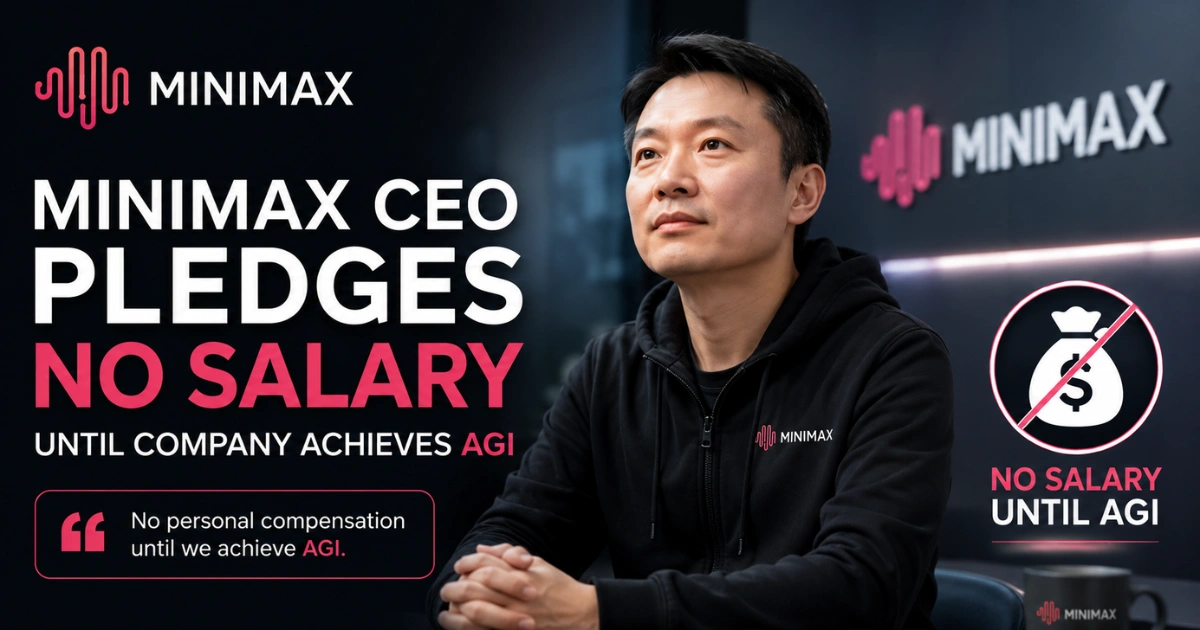

Yan Junjie picked a rough week to make a grand gesture. On the exact day MiniMax’s stock cratered following a mass lockup expiry, the 36-year-old founder, chairman, and CTO issued an internal memo pledging to take zero salary until the company achieves artificial general intelligence.
The pledge landed publicly within hours of MiniMax announcing a $2 billion emergency fundraise.
What Yan Actually Promised
The memo, reviewed by the South China Morning Post and later shared on X by a company executive, lays out the terms plainly. Effective immediately, Yan (who signs internally as “IO”) will accept no compensation from MiniMax until AGI is a reality.
Beyond the salary sacrifice, he committed to transferring 5% of the company’s total equity from his own personal holdings:
- 4% will be distributed over the next four years to reward long-tenured staff.
- 1% will seed a fund supporting open-source AI projects.
For scale, MiniMax’s 2025 annual report lists Yan’s total compensation that year at roughly $241,000. For a founder with a personal stake reportedly worth billions, analysts note this salary sacrifice is more of a symbolic gesture than a material financial hit.
Why Analysts Call It Symbolic
The backdrop of the market explains the timing of the memo better than the mission statement itself. On July 9, a combined 153 million MiniMax shares—nearly half the company’s total equity—came off a post-IPO lockup and flooded the market.
This triggered an almost 18% single-day stock drop, extending into a two-day slide nearing 30%.
That same week, MiniMax finalized roughly HK$16 billion (about $2 billion) in new financing arranged by Morgan Stanley and UBS.
The deal included a placement of 35.6 million shares at a near-10% discount and a tranche of zero-coupon convertible bonds due in 2027. Consequently, Yan’s own stake was diluted from just over 25% down to roughly 21–23%.
According to Shen Meng, a director at Chanson Capital, the pay pledge carries more narrative weight than financial substance. Founders with massive equity stakes have financial flexibility that renders a traditional salary largely irrelevant.
The Real Driver: Retention and Rivalry
The more concrete commitment is the 5% share transfer. This functions heavily as a retention tool during a critical moment when Chinese AI talent is being aggressively poached across rival labs.
MiniMax isn’t raising capital in a vacuum. Rival Zhipu AI pulled in roughly $4 billion in Hong Kong during the same week, highlighting a broader scramble for capital among China’s AI “tiger” companies. Meanwhile, investors are becoming increasingly selective, focusing heavily on which labs are actually shipping viable products.
MiniMax’s case for long-term staying power relies on the success of its M3 model, released in June.
The company claims M3 outperformed GPT-5.5 and Gemini 3.1 Pro on two closely watched coding benchmarks—a pivotal release that heavily influences the ongoing debate over open vs closed AI models in the current landscape. Ultimately, investors are pricing the company based on this product momentum, rather than the CEO’s salary headline.
Source: Official MiniMax announcement (CEO Yan Junjie's memo shared by MiniMax Developer Relations on X), "CEO Commitment to AGI and Employee Equity Plan"