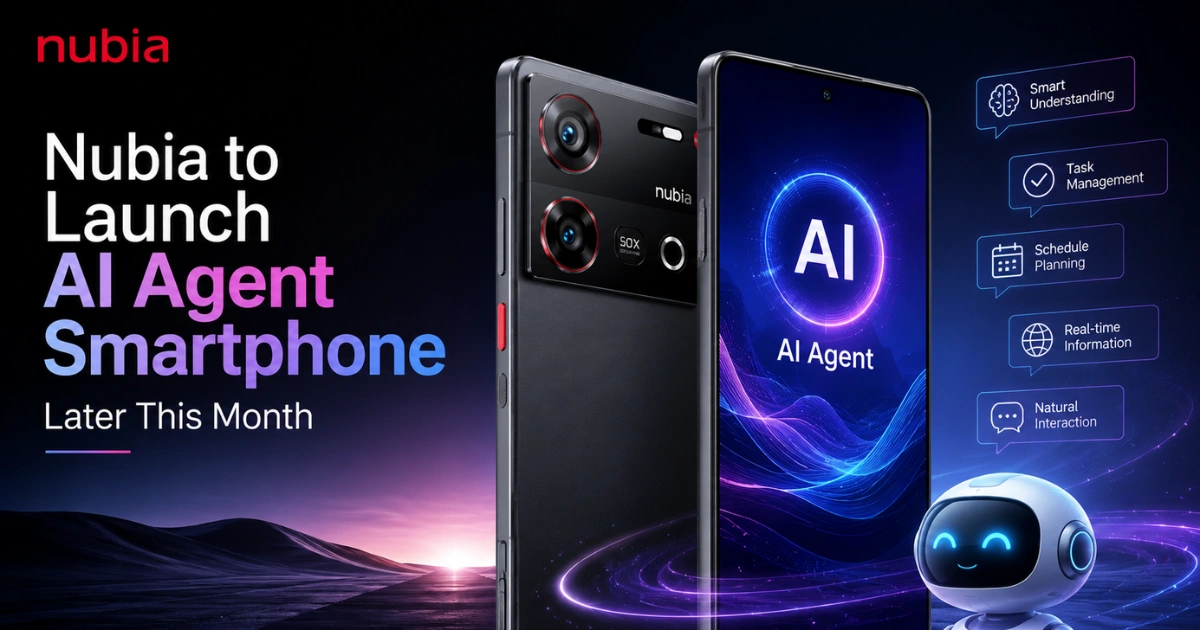

Nubia, ZTE’s AI-focused smartphone sub-brand, says it will unveil what it’s calling the world’s first AI agent smartphone at the World Artificial Intelligence Conference in Shanghai, running July 17 to 20.
Ni Fei, ZTE’s senior vice president and head of its mobile devices division, made the announcement, positioning the device as a step beyond phones that simply answer questions or generate content toward one where the AI operates the phone itself.
What the M153 already showed, and what’s still unconfirmed
The clearest signal of what’s coming is the phone’s predecessor. Nubia’s M153, a technology preview built with ByteDance’s Doubao AI assistant, launched in China in December 2025 running on a Snapdragon 8 Elite chipset with 16GB of RAM and 512GB of storage, priced at 3,499 yuan, and sold out its entire 30,000-unit first batch in a single day.
At MWC Barcelona in March, ZTE demonstrated the M153 handling multi-step tasks like restaurant bookings and price comparisons through natural-language voice commands, describing the experience as “autopilot” for the phone.
A tipster now claims the WAIC device will be a commercial successor featuring deep system-level AI integration and autonomous cross-platform operation, but Nubia hasn’t confirmed the phone’s name, its connection to ByteDance, or any hardware specifications. That confirmation is expected to arrive at WAIC itself.
Why this matters beyond one phone launch
What sets Doubao’s approach apart from most AI phones on the market is where the intelligence sits.
Rather than layering a chatbot on top of existing apps, it functions as a GUI agent that reads the screen and operates the interface directly, backed by ZTE’s own task-sequencing technology, capable in demos of comparing prices, booking travel, and completing payments without the user touching a single screen.
Samsung’s Galaxy S26 lets Gemini reach into third-party apps to handle multi-step tasks, and Apple Intelligence and Google’s Pixel line offer their own assistant layers, but none currently claim the same depth of direct operating-system control Nubia is describing.
ByteDance, for its part, has said it has no plans to build its own phones and is instead positioning Doubao as an OS-level AI layer available to multiple manufacturers, a strategy that lines up with Doubao already leading domestic Chinese AI assistants by monthly active users. That ByteDance connection cuts both ways commercially.
It gives Nubia access to one of China’s most-used AI models, but it also means any future effort to bring the phone to Western markets would run into the same regulatory friction that has already complicated TikTok’s position in the US.
For now, the launch stays firmly domestic, with pricing, specs, and any international release plans left for WAIC to answer. What Nubia has made clear is the ambition: proving an AI agent can run a phone’s operating system directly, not just talk through it.
Source: Official Nubia (ZTE) announcement, "As an AI-Native Phone Pioneer, nubia Reshapes the Paradigm of Human-Device Interaction at MWC Barcelona 2026"