
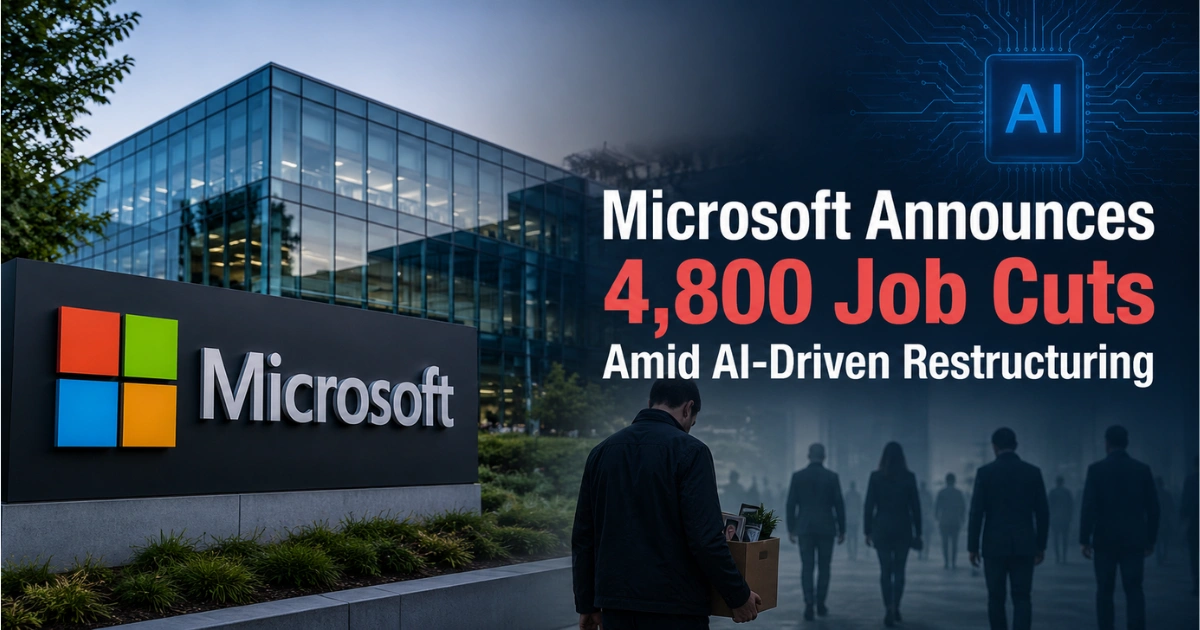

Microsoft just cut 4,800 jobs on the same day investors are watching to see whether its record AI spending will ever show up as a return.
The company announced the reduction, about 2.1% of its roughly 220,000-person global workforce, on Monday, following a stretch in which its shares fell nearly 23% over the first six months of 2026—the worst first-half performance the company has posted since 2022.
What’s Actually Being Cut
The Xbox division absorbed the deepest wound. Microsoft eliminated about 1,600 roles immediately and plans to cut another 1,600 positions by the end of fiscal 2027.
That brings total gaming-division layoffs to around 3,200 employees, or nearly one-fifth of Xbox’s global workforce. The company is also transferring four gaming studios to new management as part of the overhaul.
The rest of the cuts land in Microsoft’s commercial sales and consulting operations, which the company is restructuring as it shifts away from traditional software licensing toward AI-driven service models. This isn’t Microsoft’s first pass at trimming headcount this year either.
Earlier in 2026, the company offered voluntary buyouts to about 7% of its US workforce, close to 9,000 employees, and it has a pattern of tightening headcount near the end of its fiscal year in June as it locks in spending plans for the next one.
Brad Smith, Microsoft’s president and vice chair, framed the logic simply: the company can only remain a strong employer if the underlying business stays successful.
Why AI is Both the Reason and the Pressure
Here’s the tension sitting underneath the numbers. Azure, Microsoft’s cloud business, has been growing on the back of booming AI demand, and Azure was OpenAI’s exclusive infrastructure provider until April of this year.
But building the data centers to run that demand is expensive enough to squeeze the company’s cash flow even while revenue climbs.
Microsoft had forecast Azure sales above Wall Street’s expectations back in April, and paired that forecast with a 2026 capital spending projection of $190 billion, a number that itself blew past what analysts had modeled.
That’s the core problem: the AI buildout Microsoft is betting its future on costs more than the growth it’s currently producing can offset on its own, at least on the timeline investors are watching.
Layered on top, AI tools capable of automating routine business tasks are increasingly eating into the same enterprise software licensing revenue that has funded Microsoft for two decades, adding pressure from the demand side as well as the cost side.
Rising memory chip prices, fueled by strong AI data-center demand, also affected Xbox hardware. The higher costs forced Microsoft to increase console prices just as Xbox demand was already weakening.
The Broader Big Tech Bet
None of this is unique to Microsoft. Big Tech’s combined AI infrastructure spending is on pace to top $700 billion this year, and Amazon and Meta have both laid off thousands of employees of their own in 2026 while pushing AI investment higher.
What sets Microsoft’s version apart is the timing: cutting headcount days before an earnings report that will show, one way or another, whether the $190 billion the company is spending on AI infrastructure is starting to earn its keep, or whether the layoffs are funding a bet that hasn’t paid off yet.
Source: Official Microsoft announcement, "Message from Amy Coleman on Microsoft's Organizational Changes"