
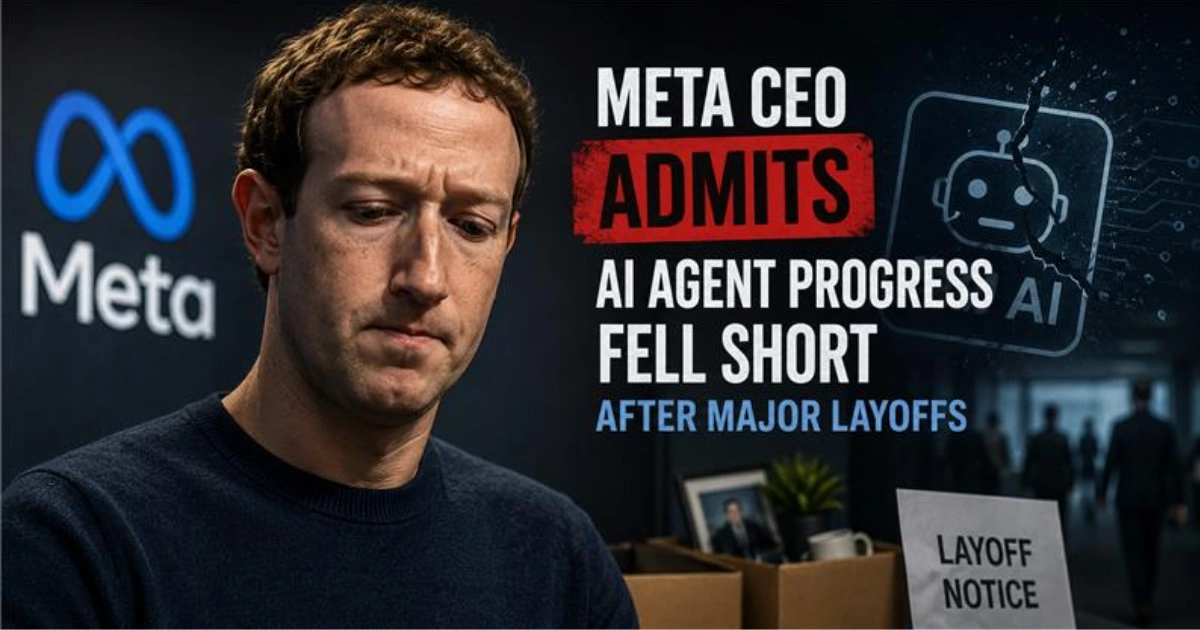

Mark Zuckerberg spent months telling Meta employees the company needed to move faster on AI, then spent an internal town hall this week admitting the plan built to make that happen hasn’t worked as intended.
According to a report by The Times of India, based on original reporting from Reuters, Zuckerberg told staff that Meta’s AI agents haven’t progressed as quickly as leadership expected, and that top executives miscalculated the timing of the restructuring built around that bet.
What Zuckerberg Actually Admitted
The numbers behind the admission are significant on their own. Meta laid off about 8,000 employees, roughly 10% of its global workforce, and reassigned another 7,000 staffers to AI-focused teams earlier this year. This was all in service of funding AI infrastructure spending projected to hit $145 billion in 2026.
Zuckerberg told employees that the trajectory of agentic development over the last four months hasn’t accelerated the way the company expected, and that the bets underlying the new structure haven’t come to fruition yet. He also acknowledged the reorganization itself wasn’t as clean as it should have been.
Notably, he pointed back to conversations with senior leadership in January and February, when the fear driving the restructuring was that Meta wasn’t moving fast enough, and admitted the company had been “super optimistic” at the time about tools like Anthropic’s Claude Code accelerating that pace.
None of this walks back the AI bet itself. Zuckerberg told staff he still expects meaningful benefits from the investment within three to six months, framing this as a timing miss rather than a strategic reversal.
The Cultural Fallout Meta is Now Trying to Contain
The town hall admission comes amid an already bruised internal culture. Meta’s Applied AI division, a 6,500-person unit created in March to accelerate generative AI work, has faced growing internal criticism.
In a memo, CTO Andrew Bosworth called the rollout “atrocious[ly].” He said the rapid restructuring destabilized teams and undermined trust, according to Wired.
Some employees reportedly described the transition as chaotic enough to compare it to a labor camp.
In response, Bosworth pledged several changes to improve morale. These include limiting managers to 20 direct reports, introducing AI coaching tools for employees, and investing in office perks such as microkitchens, travel budgets, and social events.
At the same town hall, Bosworth addressed Meta’s paused mouse-tracking software. Meta created the tool to collect employee data for AI training.
A review found that no employee data was used to train AI models. Meta also said any future rollout would be opt-in. Previously, US employees had no option to opt out.
Taken together, the town hall reads less like a single admission and more like a company trying to slow down and stabilize a restructuring it pushed through faster than its own AI progress could justify.
Meta isn’t alone in spending heavily and outrunning its own results—Big Tech’s combined AI infrastructure spending is projected to exceed $700 billion this year.
However, Meta is now one of the few companies willing to publicly acknowledge that its AI strategy has not delivered the expected results on schedule.
Source: The Times of India, "Meta CEO Mark Zuckerberg Admits AI Agents Had Not Progressed as Quickly as Expected"