
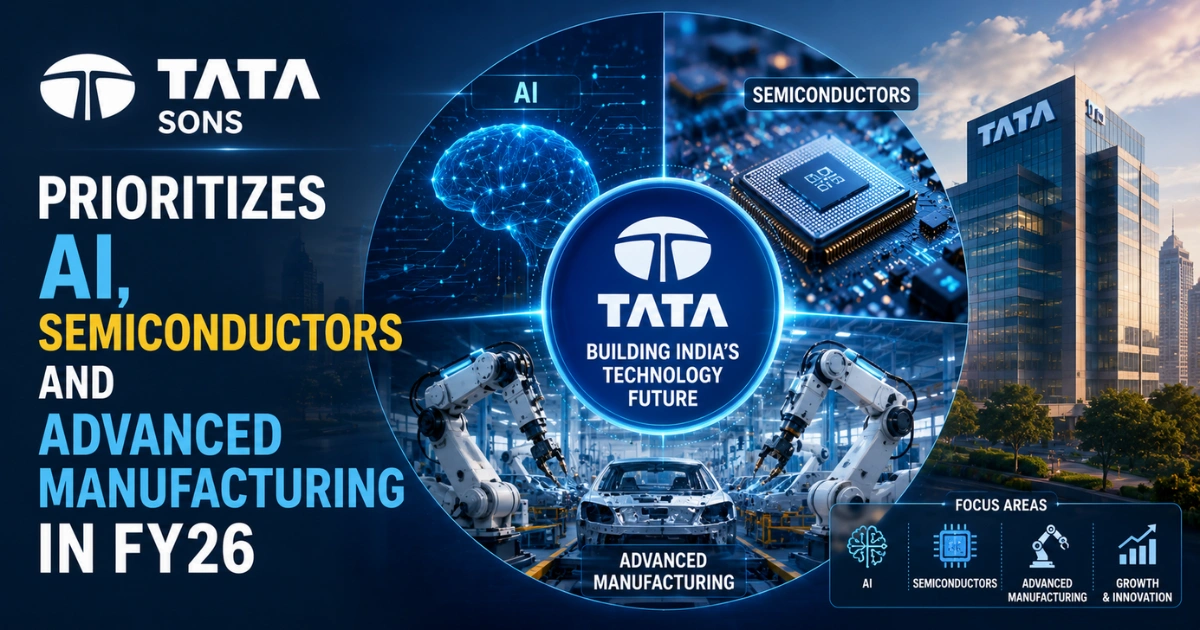

When a 150-year-old conglomerate aggressively rewrites its operational DNA to focus on silicon and neural networks, the broader market pays close attention.
Tata Sons’ FY25-26 Annual Report serves as more than just a ledger of corporate health; it is a direct blueprint for India’s technological self-reliance. Under Chairman N.
Chandrasekaran’s direction, the group is pouring significant capital into artificial intelligence, semiconductor fabrication, and advanced manufacturing.
The financial backdrop to this strategic pivot is formidable. Aggregate group revenues hit ₹16.24 lakh crore (a 7.8% bump), while profits surged an impressive 51.9% to ₹1.70 lakh crore.
By sustaining this growth despite global economic friction, Tata has heavily rewarded long-term investors, delivering total shareholder returns of 287% over the past decade—comfortably beating the Nifty 50’s 253%. Stripping out the juggernaut that is TCS, those returns jump to a staggering 575%.
The Silicon and AI Imperative
Chandrasekaran accurately frames the current AI boom not as a fleeting trend, but as a “profound, civilisational shift.”
While market skeptics worry about AI disrupting traditional IT models, Tata views it as a distinct competitive moat.
Because modern businesses require deep, complex integration of AI into tangled legacy systems, TCS is leveraging its decades-old enterprise relationships to drive this massive infrastructure transformation.
However, the real breakout story of FY26 is Tata Electronics. Scaling rapidly to ₹1.31 lakh crore in revenue and achieving operating breakeven, it has quietly become the fourth-largest entity within the Tata ecosystem.
The company isn’t just assembling parts; it is laying the literal groundwork for India’s first high-volume semiconductor fabrication plant in Gujarat.
Coupled with aggressive moves into advanced chip packaging, battery manufacturing through Agratas, and defense systems like drones and radar, Tata is actively securing the foundational hardware of the next industrial era.
Navigating Turbulence in Aviation and Digital
Progress at this scale naturally comes with friction, and Chandrasekaran’s letter to shareholders is pragmatic about the group’s operational hurdles.
Jaguar Land Rover took a sudden hit when a second quarter cyberattack forced a painful five-week production pause, highlighting the stark reality of modern supply chain vulnerabilities.
Meanwhile, Tata Digital continues to bleed capital, reporting a ₹4,974 crore loss. To correct course, the group is aggressively repositioning its Tata Neu platform to monetize its ₹46,515 crore Gross Merchandise Value (GMV) by leaning heavily into high-margin financial services, lending, and loyalty ecosystems.
Aviation remains the ultimate test of the group’s execution capabilities. Air India navigated a highly volatile FY26 marked by severe airspace disruptions, fuel cost spikes, and the tragic AI171 crash. Yet, the underlying operational metrics point to a massive cultural turnaround.
The airline swung its Net Promoter Score from a dismal -35 in FY23 to +42 by June 2026, simultaneously clinching the top spot for domestic on-time arrivals. Rebuilding the legacy carrier is a grueling five-to-ten-year marathon of fleet renewal and service upgrades, but the foundation is finally stabilizing.
Ultimately, Tata Sons is leaning into geopolitical and technological uncertainty with disciplined capital allocation.
Backed by a massive, recommended dividend of ₹1,10,717 per share, the holding company is proving that it can fund India’s industrial future without sacrificing immediate shareholder value.
Source: The Hindu, "Tata Sons to Focus on AI, Semiconductors, Aviation and Advanced Manufacturing: FY26 Annual Report"