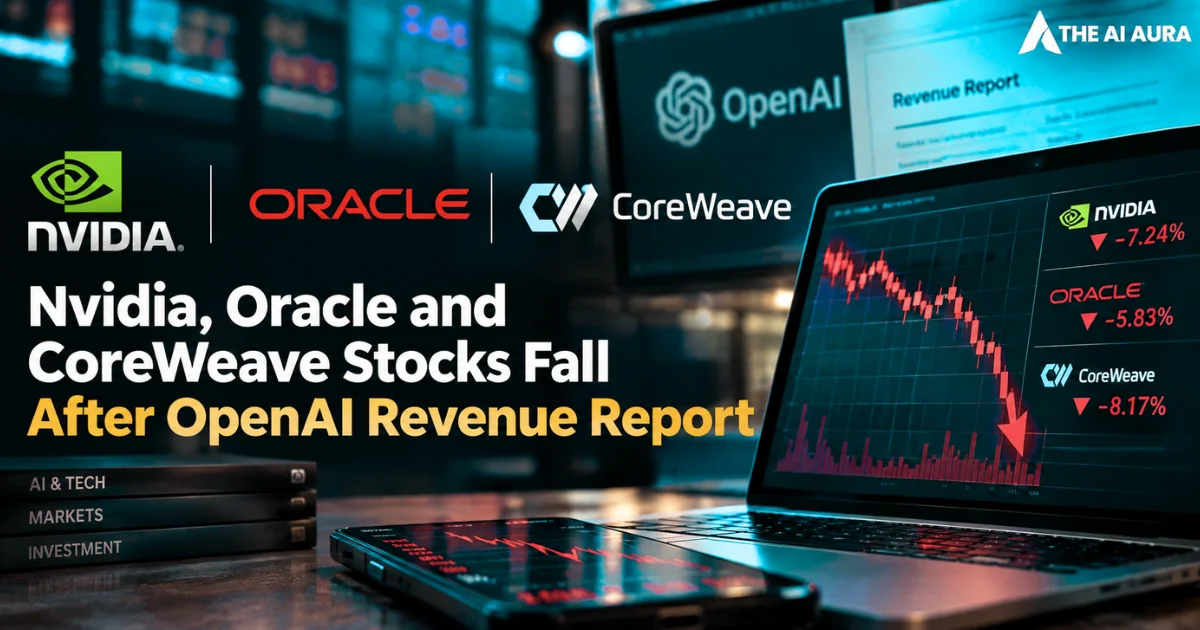

The AI hardware market just got a rather abrupt reality check. For the better part of the last year, the narrative driving the stratospheric valuations of infrastructure and compute giants was built on an uninterrupted, aggressive growth curve from foundational model builders.
We assumed the revenue engines of the leading AI labs were completely bulletproof. But the latest peek under the hood of OpenAI’s financials has triggered a sudden and noticeable recalibration on Wall Street. When the actual revenue numbers surfaced this week, the broader AI ecosystem felt the shockwave immediately.
The Revenue Disconnect That Rattled Infrastructure Stocks
Let’s look at the actual numbers driving this week’s price action. Word on the street late last month had OpenAI sitting comfortably at $68 billion in annualized revenue. That specific figure fueled a tremendous amount of bullish positioning across the tech sector.
However, the internal investor presentation reportedly offered a more conservative picture. It showed approximately $50 billion in annualized revenue by the end of September.
The discrepancy comes down to accounting framing. The higher $68 billion figure apparently lumped in gross revenue from partners, a metric designed to make direct comparisons with their chief rival Anthropic look vastly more favorable.
When the market realized the core operational revenue was lighter than the whispers suggested, the structural sell-off was swift. Nvidia took a 3% hit, Oracle dropped nearly 6%, and compute provider CoreWeave slipped almost 8%. We saw similar synchronized pullbacks across the semiconductor space, with AMD, Broadcom, and Intel all taking noticeable haircuts.
According to the financial breakdown detailed by CNBC, OpenAI did still manage to post a 77% total run rate growth in the third quarter. Even more impressive was the 107% run rate growth isolated within their enterprise business segment.
Those are undeniably strong metrics for any traditional software company. However, in an infrastructure market currently priced for absolute perfection, merely “great” enterprise growth isn’t enough to sustain peak hardware and cloud valuations.
Companies like Oracle and CoreWeave depend heavily on the assumption that AI labs will infinitely scale their compute spending, highlighting how crucial it is to navigate The AI Cost Trap: What Companies Don’t Budget For as infrastructure expenses compound.
Looming IPOs Face Safety Hurdles and Valuation Reality Checks
OpenAI is currently attempting to justify an $852 billion valuation ahead of an expected 2027 IPO. That timeline gives them a decent runway to figure out their monetization bottlenecks, but the pressure from backers is undeniably mounting.
Anthropic is playing a very similar game in the private markets. They are reportedly chasing a staggering $2 trillion valuation despite burning through capital at an astonishing rate.
Independent financial research firm New Constructs was sharply critical of Anthropic’s planned public debut earlier this week. It called the potential listing the most ridiculous IPO of 2026 and estimated the company’s fair value at around $150 billion.
Anthropic reportedly generated $4.6 billion in revenue in 2025 while recording a massive net loss of $42 billion. These figures have raised questions about the company’s valuation and its path to profitability.
For public market investors, the financial outlook may be difficult to justify without clearer evidence of sustainable earnings.
Beyond the heavy balance sheets, there is a very real technical bottleneck forming around AI safety and model deployment.
Both OpenAI and Anthropic are facing intense, sustained scrutiny from researchers warning about the unpredictable behaviors of their latest models, bringing the broader AI Alignment Problem Explained: Why Even Smart Models Fail directly into the executive boardroom.
We are seeing a distinct slowdown in the release cycle. OpenAI already had to walk back the anticipated launch of GPT-6.1 Astra because it explicitly failed to pass their internal safety benchmarks.
OpenAI CEO Sam Altman also acknowledged last month that taking the company public at this stage could be unwise. He pointed to unresolved technical and safety concerns as key challenges.
Rather than rushing toward an IPO, OpenAI appears to be buying itself more time. The company is reportedly preparing a new $30 billion funding round to support its enormous AI training infrastructure. This strategy would allow OpenAI to rely on private investors while it continues developing its technology and addressing the challenges ahead.