
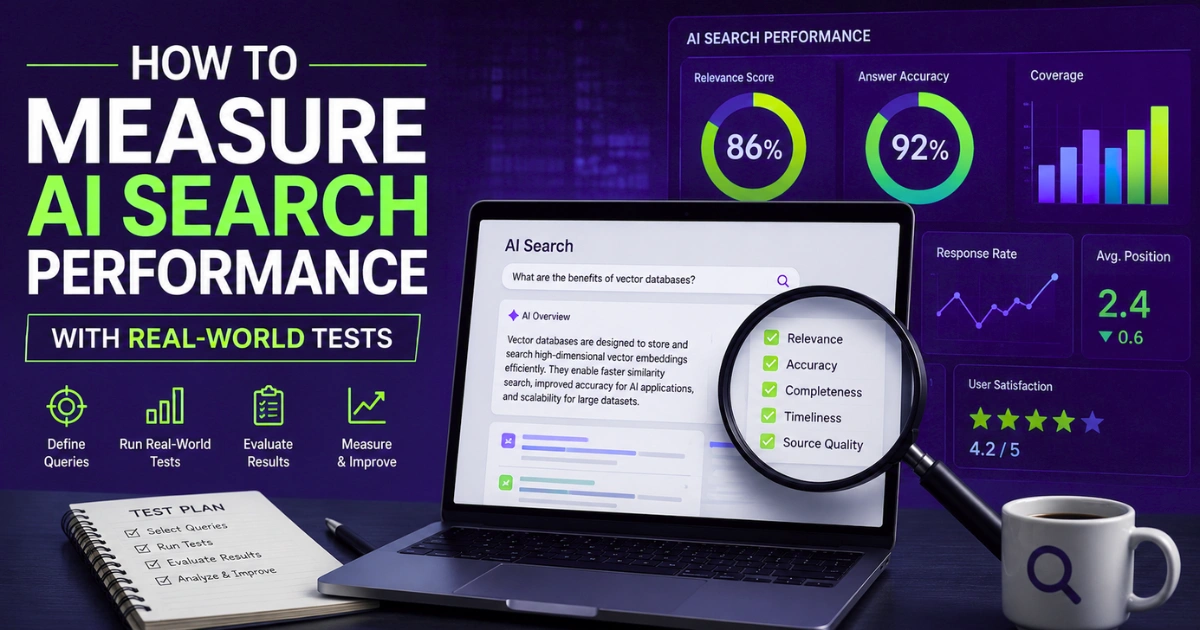

Measuring success in AI search requires a fundamental shift in how we evaluate visibility. For years, search engine optimization relied heavily on organic rankings and click-through rates.
Today, with the rapid adoption of platforms like ChatGPT, Perplexity, Gemini, and Google’s AI Overviews, the focus has expanded to tracking citations, narrative control, and model inclusion.
However, the hardest challenge search teams face right now isn’t simply checking if their brand showed up in an AI response. The real challenge is proving that specific optimizations actually caused that visibility. Visibility scores alone only offer correlation.
To understand what truly moves the needle in generative search environments, you need a highly controlled testing methodology. You have to move away from inference and guesswork, shifting toward strict, page-level split testing adapted specifically for the unique mechanics of large language models.
Strong traditional SEO—maintaining excellent technical health and well-optimized content—remains the absolute foundation, but measuring the impact of the extra layer required for AI optimization takes a new approach entirely.
Building a Framework Without Traditional A/B Testing
In traditional SEO, you can often split live user traffic to measure how a specific page change impacts conversion or ranking.
Large language models do not allow for 50-50 traffic splits, meaning you have to build a control group of correlated pages instead.
This control group acts as your primary noise filter against continuous model updates and broad algorithmic shifts. Without it, any fluctuation in your citation rate is indistinguishable from background noise.
To begin measuring accurately, you must develop a curated “golden set” of prompts that span your entire user journey, from top-of-funnel awareness to retention. Organize these prompts into tiers based on your current visibility within the AI’s responses.
Start with the easiest opportunities first. Focus on prompts where your brand is already relevant but the AI still lacks a strong page to cite.
Once your prompt set is ready, timing becomes critical. You must establish a quiet baseline period before deploying any page-level changes, followed by a strict, extended test window.
AI search engines do not always crawl and render updates as instantly as traditional search bots. Cutting a test window short almost guarantees that you will be reading inaccurate data.
Proving Causation Through Intentional Reversion
True measurement requires undeniable proof that a specific action drove a specific result. A prime example of this methodology in action involves testing formatting changes, such as injecting comprehensive FAQ sections into target pages. In controlled enterprise tests tracking hundreds of prompts, adding these structured FAQ sections immediately lifted AI citations compared to the designated control group.
However, the ultimate proof of success wasn’t just the initial upward trend. To prove causation, you have to revert the change. When the FAQ sections were removed, citations quickly returned to their original baseline.
That intentional reversion is the gold standard of AI search measurement: proving strict causation rather than leaning on circumstantial correlation.
Gaining access to clean data to track these tests is also improving. While third-party tracking remains absolutely necessary for platforms like Claude and ChatGPT, Google’s recent addition of dedicated Search Console reports for AI Overviews and AI Mode provides a massive first-party data advantage.
It allows you to see exact, page-by-page rendering within Google’s specific generative ecosystem. Combining this definitive first-party data with rigorous, correlated control groups across all other third-party models is how modern search teams secure their budget.
This shifts the focus from traffic speculation to narrative control. Even without a direct click, AI can still present your brand’s key strengths and comparisons accurately.
Source: Official Search Engine Journal "AI Search is Working. How to Prove It With Real Tests."