Exploring AI, One Insight at a Time

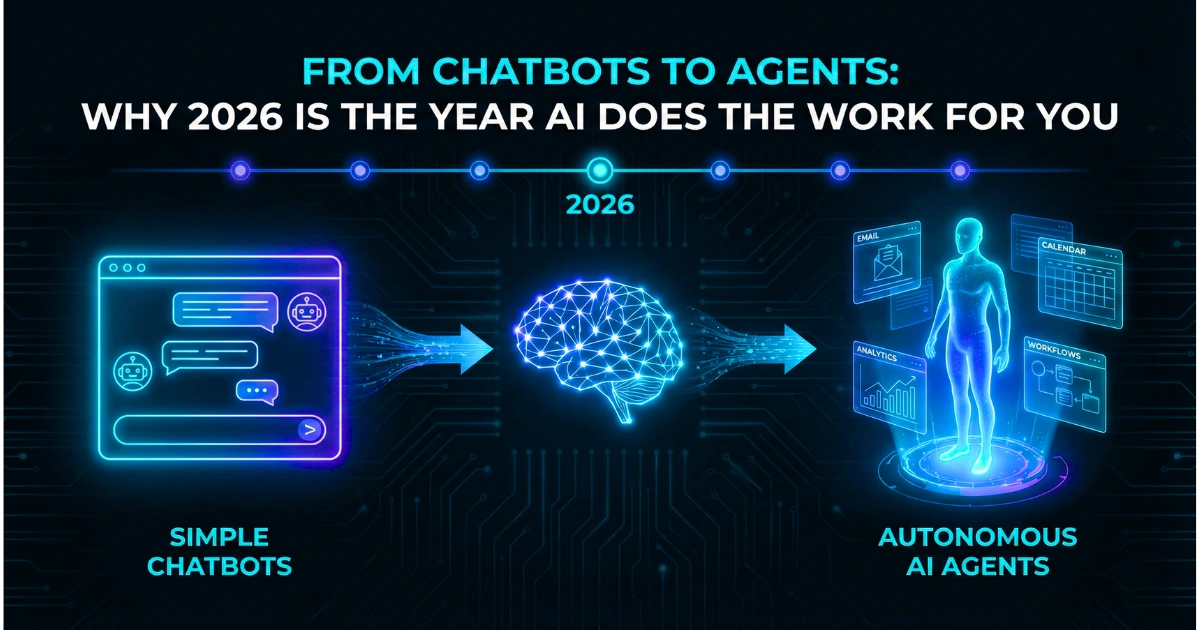
From Chatbots to Agents: Why 2026 is the Year AI Does the Work for You

I haven’t typed a prompt into a chatbot in three weeks. And honestly? Good riddance.
For the last three years, the tech industry tried to convince us that the pinnacle of human-computer interaction was a text box. We were told to marvel at the “conversation.” But we confused novelty with utility. The reality is that talking to software is exhausting. It requires context, prompting strategies, and endless patience.
We didn’t want a chat partner. We wanted a digital intern who shuts up and does the filing.
That’s why 2026 isn’t about the model’s IQ. It’s about the model’s hands. The chat interface is dying, replaced by silent, headless agents that execute work while you sleep.
The “Devin” Fallacy and the Autonomy Trap
Remember the hysteria around “Devin” back in early 2024? Cognition Labs dropped a demo of an “autonomous software engineer” and Twitter (I still refuse to call it X) melted down. Founders terrified their engineering teams; VCs poured billions into “coding agents.”
We all missed the point.
The problem with 2024-era agents wasn’t that they couldn’t code. It was that they were needy. They required constant supervision. You spent more time debugging the agent’s logic than you would have spent writing the function yourself. It was “autonomy” in name only.
What I’m seeing now, in 2026, is the over-correction. The most successful startups aren’t building “general purpose employees.” They are building boring, hyper-specific agents. I spoke to a founder last week whose entire Series B company does one thing: An agent that navigates government procurement portals to upload compliance PDFs.
It doesn’t chat. It doesn’t write poems. It just logs in, clicks the terrible JavaScript buttons that break standard scrapers, and uploads the file. That’s not “artificial intelligence.” That’s just labor arbitrage.
When the “Co-Pilot” Becomes the Pilot
The “Co-Pilot” narrative—pushed heavily by Microsoft and GitHub for years—was a brilliant liability shield. If the human is the pilot, the human is responsible when the code breaks production.
But that safety blanket is suffocating efficiency.
We are finally seeing the “human in the loop” becoming the bottleneck. If an agent has to wait for me to approve every email draft, it’s not an agent; it’s a spell-checker with an ego.
The Salesforce Pivot
Look at Marc Benioff’s aggressive pivot to “Agentforce” back in late ’24 and throughout ’25. He realized earlier than most that the CRM is a dead end if it relies on humans to input data. Salespeople hate data entry. They always have.
The shift we are living through now is from Systems of Record (keeping track of what happened) to Systems of Action (making things happen).
I’ve seen enterprise deployments this year where the “user” never logs into Salesforce. An agent monitors an inbox, updates the opportunity stage, drafts the contract, and sends it for e-signature. The human only gets involved if the deal value is over $50k or if the client replies with an angry sentiment score.
The Interface is “No Interface”
Conventional wisdom still assumes that as AI gets better, the conversation gets deeper. Wrong. As AI gets better, the conversation disappears.
If I have to ask my travel agent bot to “book a flight,” it has failed. A true agent knows my calendar, knows I have a board meeting in London on Tuesday, sees the flight prices dropping, and just sends me a push notification: “I booked seat 4A on BA293. Refundable until 24h prior. Tap to cancel.”
This is a terrifying shift for founders building “conversational interfaces.” If your product relies on a user typing into a box, you are building a legacy app. The winners of 2026 are building the infrastructure that lets agents talk to other agents, bypassing the messy, slow, biological layer entirely.
The Bottom Line
The novelty of the “chat” is dead; the era of the “task” has arrived. We are moving from a world where we pay for software seats to a world where we pay for outcomes—bugs fixed, leads qualified, meetings booked. For founders, this is an existential threat to the SaaS business model. You can’t charge $30/month per user when the user is a script running in the cloud. Adapt your pricing to the work done, or die holding onto your per-seat license.
