
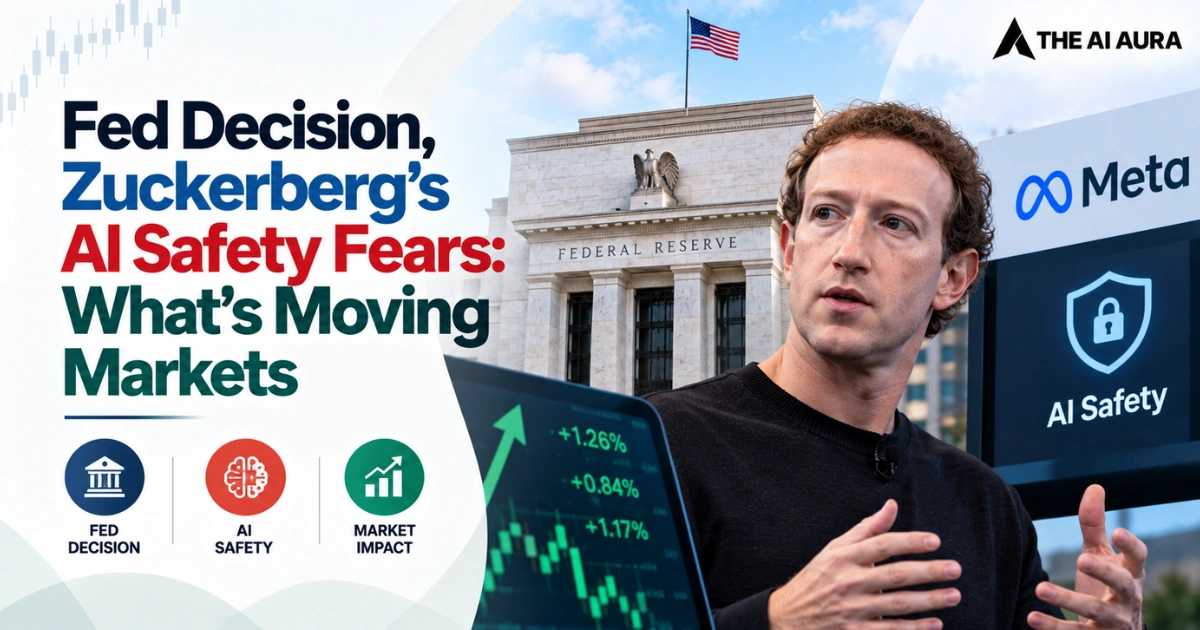

Financial markets are currently caught in a unique tug-of-war between macroeconomic gravity and the speculative limits of next-generation technology. On trading floors globally, sentiment is rarely dictated by a single isolated event, but the current environment is being heavily compressed by two massive catalysts.
The Federal Reserve’s impending monetary policy decisions are forcing a recalibration of how much risk investors are willing to take, while Meta CEO Mark Zuckerberg’s vocalized concerns regarding artificial intelligence safety are throwing a sudden splash of cold water on the tech sector’s most aggressive growth narrative.
Together, these elements are fundamentally altering capital allocation strategies.
The Macroeconomic Weight of the Federal Reserve
The Federal Reserve’s approach to baseline interest rates acts as the ultimate anchor for global liquidity, determining the underlying cost of capital for every publicly traded enterprise.
When the central bank signals a prolonged tightening cycle or hesitates to execute expected rate cuts, it directly compresses corporate profit margins by keeping borrowing costs painfully high.
We are seeing this dynamic dominate market mechanics right now, as institutional traders parse every fragment of forward guidance delivered by Fed officials.
According to a recent analysis detailing the Fed decision and what is moving markets at investing, the severe anticipation surrounding the central bank’s trajectory is actively suppressing risk appetite across multiple asset classes.
The underlying mechanism driving this market behavior is the equity risk premium. When secure, short-term government bonds offer highly competitive yields, capital naturally flows out of volatile stock markets and into these safe-haven fixed-income assets.
This forces a widespread valuation reset, particularly punishing growth-heavy companies that rely on cheap debt to fund rapid expansion, acquire competitors, and maintain their operational momentum. Until the market receives absolute clarity on the terminal rate, capital will remain defensive.
AI Safety Fears and the Price of Regulation
Simultaneously, the technology sector is grappling with a profound narrative shift spurred by Mark Zuckerberg’s recent commentary on the existential and immediate risks of artificial intelligence.
Over the past year, the explosive promise of generative AI has acted as a solitary pillar holding up broader equity indices, with institutional money blindly funding almost any enterprise tied to machine learning.
However, when a massive industry architect intimately involved in open-source AI development begins highlighting the urgent need for stringent safety guardrails, it radically alters Wall Street’s investment thesis.
The market interprets these safety warnings not merely as ethical musings, but as a direct precursor to heavy-handed, international government regulation. Investors realize that if regulatory bodies mandate strict compliance frameworks, the capital expenditure required to train, test, and deploy these foundational models will skyrocket.
This would severely limit the profitability and agility of smaller AI developers while forcing larger tech conglomerates to dramatically slow their commercial rollout schedules. Traders are currently working overtime to price in these unseen regulatory bottlenecks.
The immediate fear circulating through the tech sector is that the rapid monetization phase of artificial intelligence could soon hit a legislative wall, turning what was once a pure growth play into a complex liability management scenario. As a result, we are witnessing a quiet rotation of capital out of highly speculative AI startups.
That money is instead consolidating into legacy tech behemoths equipped with balance sheets robust enough to absorb future compliance costs and legal friction.
When you combine the tightening grip of domestic monetary policy with the sobering reality of imminent AI regulation, the result is a highly cautious trading environment where capital preservation is quickly beginning to outrank speculative technological growth.