
The financial world currently faces a tug-of-war between technological optimism and historical pragmatism. Every few decades, a new innovation emerges. It fundamentally alters global markets and prompts a massive capital influx.
Today, artificial intelligence serves as that catalyst. Silicon Valley champions this era for its unprecedented productivity. However, seasoned financial minds view the inflating valuations with deep skepticism.
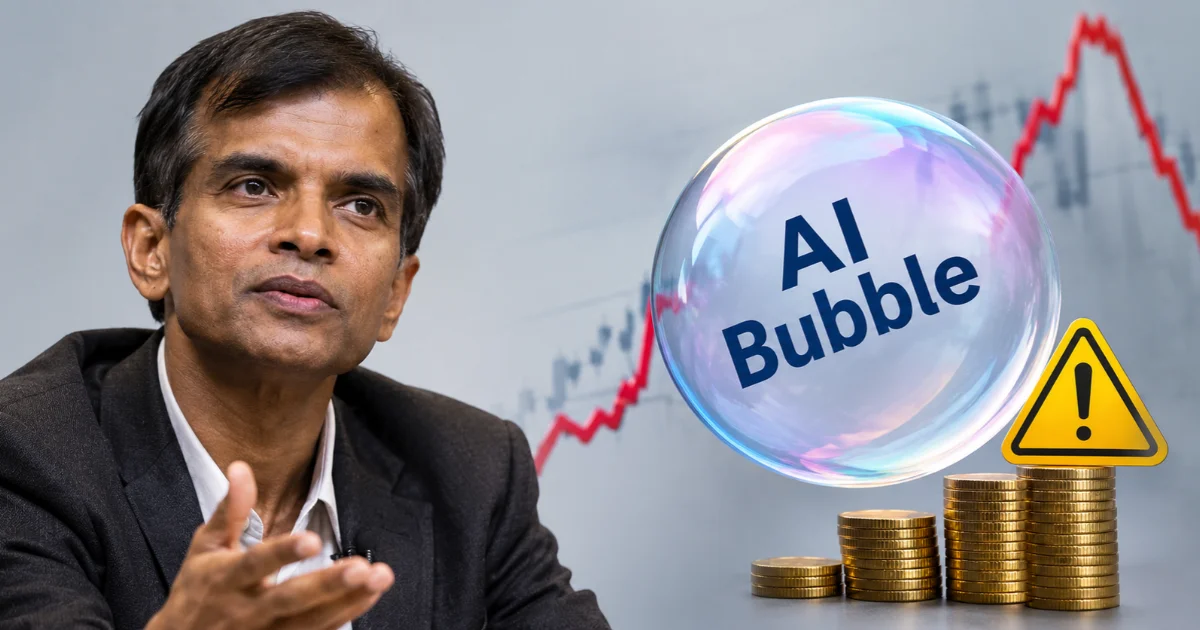
Aswath Damodaran recently voiced a sobering reality check. Many consider him the top authority on corporate valuation. He appeared on a recent podcast and made his stance clear. The market is hurtling toward an AI bubble.
More importantly, we cannot avoid the impending fallout. Understanding this market cycle requires examining the psychological triggers that started the frenzy.
The Catalyst Behind the Market Frenzy
How did Wall Street reach this precarious juncture? We must look at the exact moment the narrative shifted. Damodaran traces the roots of the current market mania back to November 30, 2022.
This was the day OpenAI officially unveiled ChatGPT to the public. Before this release, machine learning mostly stayed in academic discussions and backend enterprise applications.
The technology existed, but it lacked a tangible, user-friendly interface that the general public could easily grasp.
According to a comprehensive market analysis published at The Economic Times, Damodaran noted that while the initial iteration of the chatbot was relatively low-tech compared to what is being developed now, it served a crucial psychological purpose.
It abruptly brought nascent artificial intelligence into mainstream public consciousness. Almost overnight, retail investors, venture capitalists, and institutional fund managers realized the disruptive potential of the technology.
This sudden awakening triggered a gold rush mentality. Companies began appending the term AI to their press releases and earnings calls, regardless of their actual technological capabilities, knowing that the mere mention of the acronym would inevitably drive up their stock prices.
The market stopped valuing companies based on their current cash flows and started pricing in a utopian future that many of these firms simply will not survive to see.
Valuation Realities and Defensive Strategies
The mechanics of a financial bubble are remarkably consistent throughout history, whether driven by railroads, the internet, or generative algorithms. A bubble forms when the pricing of an asset detaches entirely from its intrinsic economic value, driven instead by momentum and the fear of missing out.
Damodaran warns that the AI sector has crossed this threshold. Capital is being deployed at a rate that far exceeds the near-term revenue potential of the underlying technology.
Hardware manufacturers and chip designers have seen their market caps swell to historic proportions, while software companies are burdened with immense infrastructure costs that they struggle to monetize efficiently.
The inevitable correction will occur when the market suddenly demands to see actual, sustainable profits rather than mere user growth or technological promises.
For investors trying to navigate this landscape, the strategy must pivot from speculative growth to strict fundamental analysis.
Damodaran advises market participants to completely ignore the hype cycle and return to the bedrock of investing, which is assessing a company’s ability to generate reliable cash flows.
This means separating the businesses that are actively building essential, profitable AI infrastructure from the thousands of peripheral companies simply riding the marketing wave.
When the inevitable contraction begins, the market will mercilessly wipe out the speculative players, leaving only those with solid balance sheets and realistic business models intact.