
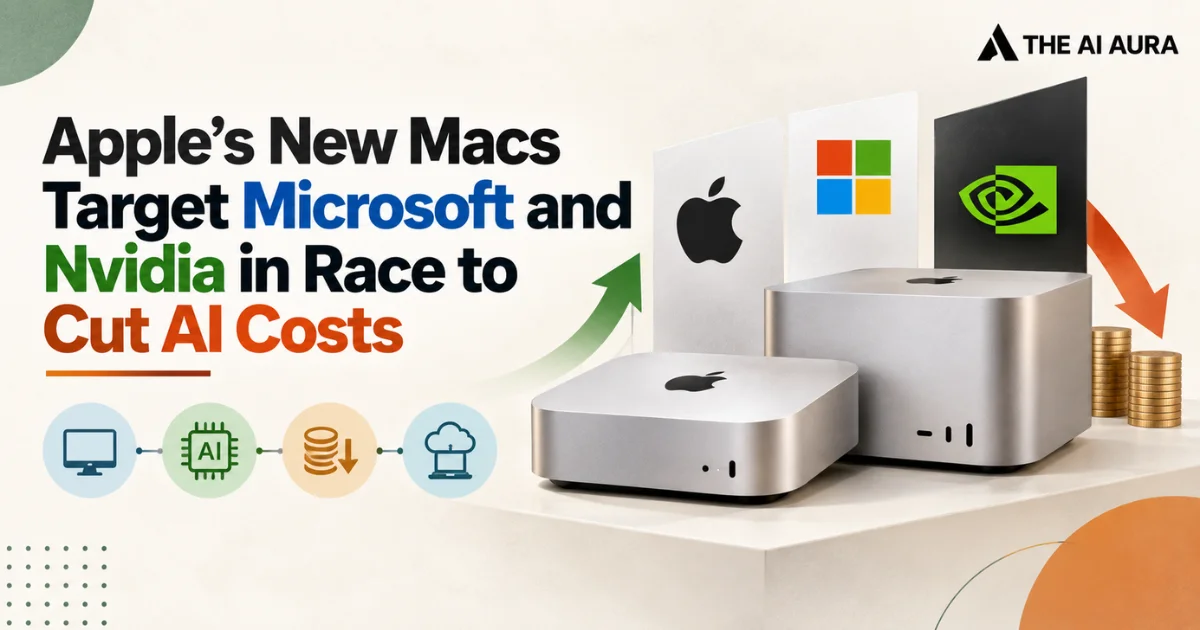

When Apple’s latest lineup of desktop computers begins shipping to corporate clients, the sales pitch will sound surprisingly different from the company’s usual focus on creative professionals and video editors. Apple executives are strategically positioning their new silicon as a direct financial antidote to the skyrocketing costs of modern computing.
The core argument being presented to enterprise buyers is highly pragmatic: buying a fleet of high-end Macs is now demonstrably cheaper than continually renting server space in data centers to run artificial intelligence models.
For the past few years, the enterprise AI narrative has been entirely dominated by cloud giants like Microsoft and hardware monopolies like Nvidia, who together control the massive server farms processing the world’s generative AI workloads.
Apple is looking to disrupt this expensive dependency by bringing the processing power back to the local desk, aiming directly at the wallets of corporate finance officers who are currently experiencing severe sticker shock from their monthly cloud computing bills.
Shifting from Cloud Rentals to Owned Hardware
The generative AI boom created massive recurring revenue for cloud providers. Yet for enterprise adopters, the financial strain is becoming unsustainable. Employees trigger micro-transactions every time they prompt an internal tool or run analytics. These costs quickly add up on Nvidia-backed cloud clusters.
According to a recent analysis by Moneycontrol, Apple is actively capitalizing on this exact market frustration by encouraging enterprise buyers to shift from a perpetual rental model to an ownership model.
By running highly optimized models locally on a new Mac desktop, a business effectively eliminates the meter running in the background. The initial capital expenditure of purchasing the Apple hardware is recouped rapidly when compared to the relentless monthly operational expenses associated with cloud-based AI queries, ongoing data transfer fees, and server maintenance.
Furthermore, processing sensitive corporate data entirely on device inherently removes the severe privacy and security risks associated with beaming proprietary information to a third-party data center.
The Technical Advantage of Unified Memory
Apple’s strategy relies on the unique architecture of its custom silicon. Traditional PCs separate system RAM from dedicated video memory. As a result, running large models requires expensive graphics cards with massive VRAM capacity.
Apple avoids this bottleneck through its unified memory architecture. The CPU, GPU, and Neural Engine share a single high-speed memory pool. Because of this, a desktop Mac can easily load colossal language models. In contrast, cloud setups require expensive Nvidia GPU clusters for the same task.
Unified memory also removes the need to transfer data across different components. This drastically reduces both latency and power consumption. Macs do not match server farms in raw model training. However, they aggressively excel at local inference. Employees can generate text, code, and data analysis in real time right from their desks.