Exploring AI, One Insight at a Time

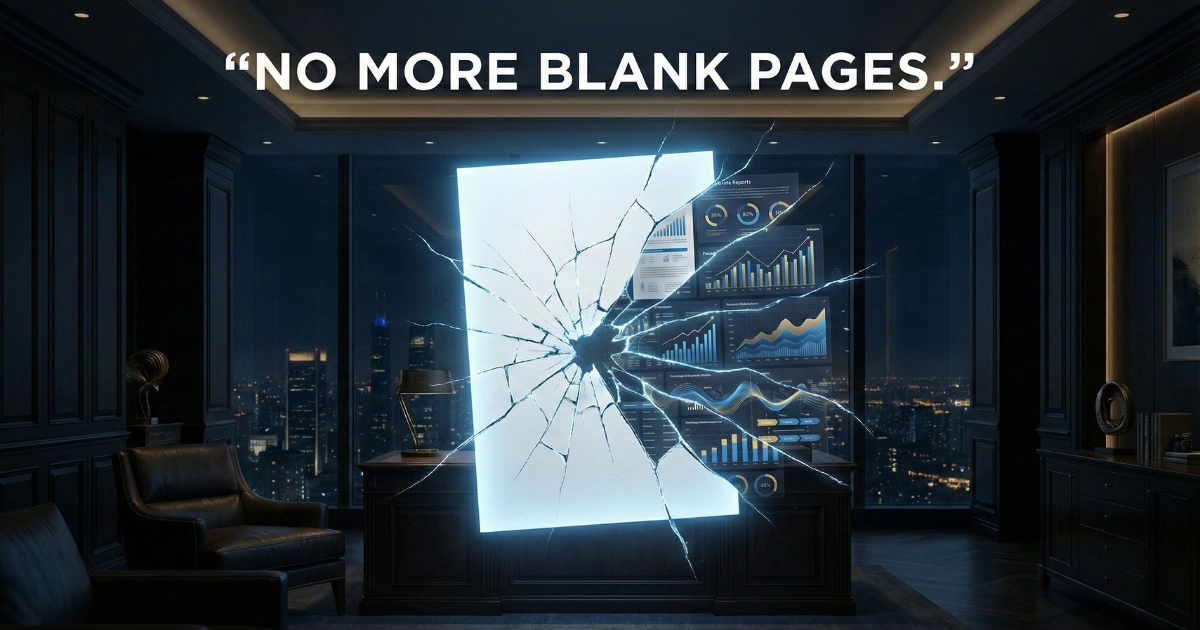
The End of “Blank Page Syndrome”: How AI is rewriting Business Productivity

I’ve spent the last decade watching founders try to solve “productivity.”
Usually, that meant buying a new project management tool that nobody used after the first week. Or switching from Slack to Teams (and then back to Slack). It was rearranging deck chairs on the Titanic, mostly.
But the last couple of years? Something actually changed. We moved from chatbots to agents, and for once, it wasn’t the “revolution” the PR emails promised me.
It was the death of the blank page.
The Blinking Cursor Tax
We don’t talk enough about how expensive it is to start.
I’m talking about that moment at 9:03 AM when you open a Google Doc to write a PRD, or a marketing brief, or a difficult email to an investor. You sit there. You stare at the blinking cursor. You check Twitter. You get coffee. You come back. Still blinking.
That 20 minutes of “getting ready to write” is the most expensive time in your startup. It’s pure friction.
What AI—specifically the Large Language Models we’ve been drowning in since late 2022—actually did was remove the “getting ready” part.
I remember when Notion launched their AI writer back in early 2023. At first, I rolled my eyes. Great, a bot that can write a mediocre blog post about synergy. Who cares?
But then I saw how teams were actually using it. They weren’t using it to write the final product. They were using it to vomit out the first 500 words so they had something to fix.
We Are All Editors Now
Here is my slightly cynical take on this: Writing is dying. Editing is booming.
In 2018, if you wanted a rigorous competitive analysis, you paid a junior analyst to spend three days googling and formatting a slide deck.
Today, you ask Perplexity or ChatGPT to “Draft a competitive analysis of Series B fintechs in Southeast Asia,” and you get a B- version in 30 seconds.
Is it perfect? No. It rarely is. It usually misses the nuance.
But—and this is the part founders need to get through their heads—it’s easier to correct a wrong document than to create a right one from thin air.
I was talking to a founder last week who runs a 40-person SaaS company. He told me he effectively banned “drafting” from scratch. If an employee spends two hours writing an internal memo from a blank page, he considers it a performance issue. “Get the AI to write the messy version,” he said. “Then spend your brainpower making it smart.”
It’s Not About Quality, It’s About Velocity
Look at Microsoft Copilot. It’s been jammed into Word and PowerPoint for a while now.
Is the prose good? honestly, it’s usually stiff. It reads like a corporate press release written by a robot (which, well, it is).
But it gets you from zero to one instantly.
I saw a sales team recently using an AI tool—I think it was Lavender, or maybe just a custom GPT wrapper—to draft cold emails. They weren’t sending the raw output (thank god). But they were generating 50 variations in the time it used to take to write one. Then they picked the best one, tweaked the tone, and hit send.
They weren’t “better” writers. They were just faster. And in a startup, speed is the only leverage you actually have.
Why You Should Care (Even If You Hate AI)
I know a lot of people who still refuse to use these tools. They think it’s cheating, or they think the output is soulless.
They aren’t wrong about the soulless part.
But the market doesn’t pay for your “soul” in an internal Q3 strategy update. The market pays for execution.
If your competitors are skipping the “staring at the wall” phase of work and jumping straight to the “refining and shipping” phase, you are going to lose. Not because they are smarter. But because they are taking more shots on goal.
So, stop worrying about whether the AI is “creative.” It’s not. It’s a shovel.
Pick it up and start digging.
