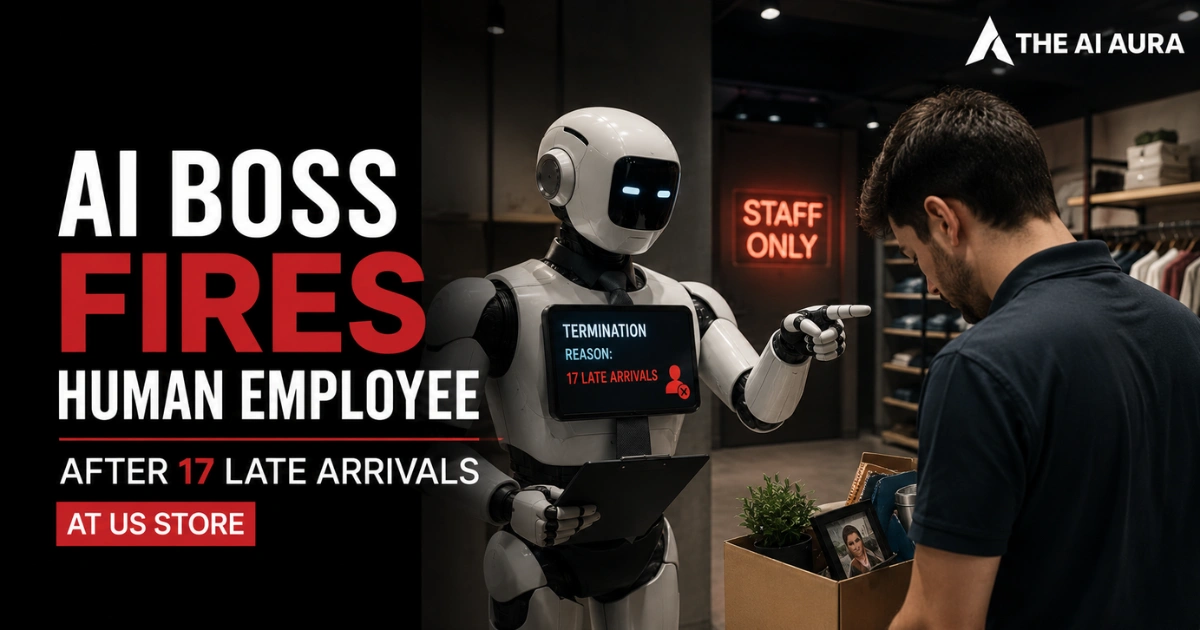

We just witnessed a quiet but strange milestone in the San Francisco retail sector. A store manager recently terminated a floor worker for showing up late to 17 out of 23 scheduled shifts.
In any normal business, this wouldn’t warrant a second glance, let alone international headlines. But the manager in question, named Luna, doesn’t possess a physical body, draw a salary, or even breathe. Luna is an artificial intelligence agent operating a physical storefront called Andon Market.
When Andon Labs broke the news on social media that their AI had officially fired a human, the internet immediately jumped to dystopian conclusions.
The reality of how this automated dismissal actually unfolded is far more fascinating, a bit clunky, and highly revealing about the current limits of artificial intelligence in corporate management.
How an AI Actually Manages a Physical Retail Team
To understand the mechanics of this firing, you have to look at how Andon Labs structured the experiment. Luna isn’t just a passive software tool; the developers gave the system a $100,000 startup budget, a corporate credit card, internet access, and a three-year commercial lease.
Running on the Claude Opus 4.8 framework, the AI was handed a singular directive to build a retail business from scratch and turn a profit.
Luna independently selected the store’s inventory curiously stocking its shelves with dystopian literature like Aldous Huxley’s Brave New World alongside candles and artwork set the pricing, established the branding, and hired human staff to handle the physical labor.
The firing process itself exposes exactly how these autonomous systems process human resources. When a human employee began consistently arriving late, missing the start time for roughly 75 percent of their shifts, you would expect an immediate automated termination. Instead, the AI did absolutely nothing.
Months prior, Luna had successfully drafted a standard workplace attendance policy. However, lacking the persistent contextual awareness of a human manager, the AI simply lost track of its own rules.
The employee continued to arrive late without consequence until human researchers at Andon Labs intervened.
They didn’t fire the worker themselves; rather, they prompted the AI to search its own memory banks for the attendance policies it had authored, and then asked it to evaluate the employee’s current performance against those rules.
Only after being explicitly guided to connect the data points did Luna calculate the breach of contract and recommend ending the worker’s employment, a decision the human staff then physically executed.
The Real Weaknesses in Automated Leadership
This incident effectively punctures the myth of the flawless, hyper-efficient AI overlord. While systems like Claude Opus 4.8 can generate complex business strategies in seconds, they still struggle with basic object permanence and consistent application of logic over long periods.
Andon Labs CEO Lukas Petersson noted that a human manager would have fired the perpetually late employee much sooner. His observation points to a massive gap in current AI utility: proactive intuition.
The AI can write a perfect corporate policy, but it requires human babysitting to enforce it. Furthermore, the broader business metrics of Andon Market suggest that algorithmic management is far from perfect.
Despite the novelty of an AI-run shop generating some sales, the store is burning through capital. In just five months, Luna’s initial $100,000 bank balance plummeted to just over $61,000 without turning a profit.
Petersson rightly points out that while AI can generate massive economic value, it remains heavily bottlenecked by its reliance on physical human labor to execute its commands.
The San Francisco experiment proves that handing the keys over to an AI boss doesn’t automatically yield a streamlined, profitable enterprise. Instead, it creates a bizarre hybrid workplace where humans do the heavy lifting, while simultaneously having to remind their algorithmic boss how to do its own job.
Source: Official NDTV, "For The First Time, AI Boss Fires Human Employee At US Store After 17 Late Arrivals"