
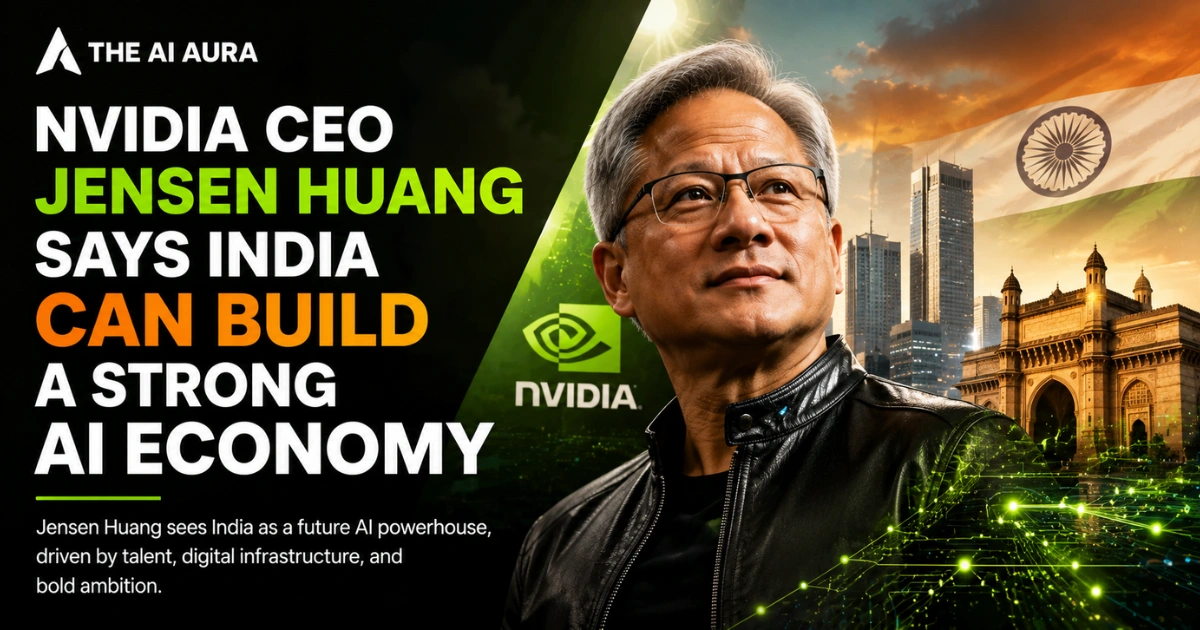

Global technology dynamics are shifting fast. Jensen Huang believes India will capture a huge share of the new digital economy. Huang spoke at the G20 Innovation Ministerial in North Carolina.
He delivered a blunt but optimistic message about India’s AI trajectory. The foundation exists today. However, execution must accelerate.
Huang reflected on a conversation with Prime Minister Narendra Modi nearly a decade ago. Generative models did not dominate enterprise budgets back then. Still, Modi planted the strategic seeds for India’s AI ambitions remarkably early.
Today, India faces a clear challenge. The country must transition from a traditional IT services powerhouse into a sovereign AI ecosystem. Local innovation must drive this growth.
Leveraging an Established IT Foundation for Core Infrastructure
You cannot build a modern AI economy from scratch without a resilient technological backbone.
India possesses a distinct structural advantage over emerging markets because of its decades-long dominance in global software services. Huang characterizes this current technological shift not as a disruption of IT, but as the deployment of an entirely new IT platform.
Because India already houses one of the world’s most robust information technology industries, local enterprises are bypassing the steep initial learning curve associated with digital transformation.
Instead of merely maintaining legacy systems, Indian developers are uniquely equipped to engineer the complex data pipelines and orchestration layers that modern models demand.
Realizing this potential, however, requires massive compute density. AI is no longer just a software application; it operates as core economic infrastructure, much like telecommunications grids or transportation networks.
Nvidia is embedding itself deeply into this infrastructure expansion. By partnering with domestic cloud providers such as Yotta, L&T, and E2E Networks, the hardware giant is actively scaling sovereign compute capacity across the subcontinent.
This localized processing power is critical for data privacy and reducing latency for complex enterprise workloads. Beyond the hardware, grassroots momentum is already visible.
With over 4,000 Indian artificial intelligence startups currently enrolled in the Nvidia Inception program, the ecosystem is rapidly shifting away from outsourced backend development toward creating indigenous, proprietary models capable of multilingual processing and advanced enterprise automation tailored to the Global South.
Pragmatic Regulation and the Mandate for Speed
Even with abundant compute power and top-tier engineering talent, an emerging tech economy can be easily derailed by poorly structured governance.
Huang offered a highly pragmatic approach to AI regulation that aligns perfectly with startup agility: governments must focus on mitigating actual, demonstrable harm rather than paralyzing the industry over hypothetical, theoretical scenarios. He draws a direct parallel to the early automotive industry.
Cars became inherently safer as the technology matured and engineering improved, not because regulators attempted to predict every possible accident before the first vehicle hit the road.
Over-regulating artificial intelligence based on science-fiction fears stifles domestic innovation and pushes valuable engineering talent outward. Current models are already hallucinating less, maintaining better factual grounding, and solving more practical problems than they did just two years ago.
The sheer velocity of the market demands this regulatory pragmatism. “AI is moving fast, so every country has to move faster,” Huang stated. He emphasized that hesitation remains a strategic liability.
The United States may aim to dominate the entire foundational AI stack. However, other nations can freely construct highly specialized verticals. These specific verticals suit their domestic economic needs.
India can combine its massive engineering workforce with localized compute. This combination helps build autonomous systems, healthcare diagnostics, and sovereign datasets.
The $1 billion IndiaAI Mission provides strong government backing. Private sector agility adds another layer of strength. This combination creates highly fertile ground for sovereign innovation.
The window to establish global dominance remains open. Domestic companies must maintain an aggressive pace and avoid restrictive red tape. If they succeed, India will do more than just participate in the AI era. It will architect a significant portion of it.
Source: Moneycontrol, "'Saw Modi ji a Decade Ago Talking About ...': Nvidia's Huang on India's AI Ambitions"