

Wall Street has evaluated Microsoft through a narrow lens for years. For a decade, the company reported revenue across three distinct pillars: Productivity and Business Processes, Intelligent Cloud, and More Personal Computing.
That model made sense when enterprise software, hosting, and consumer hardware remained separate businesses.
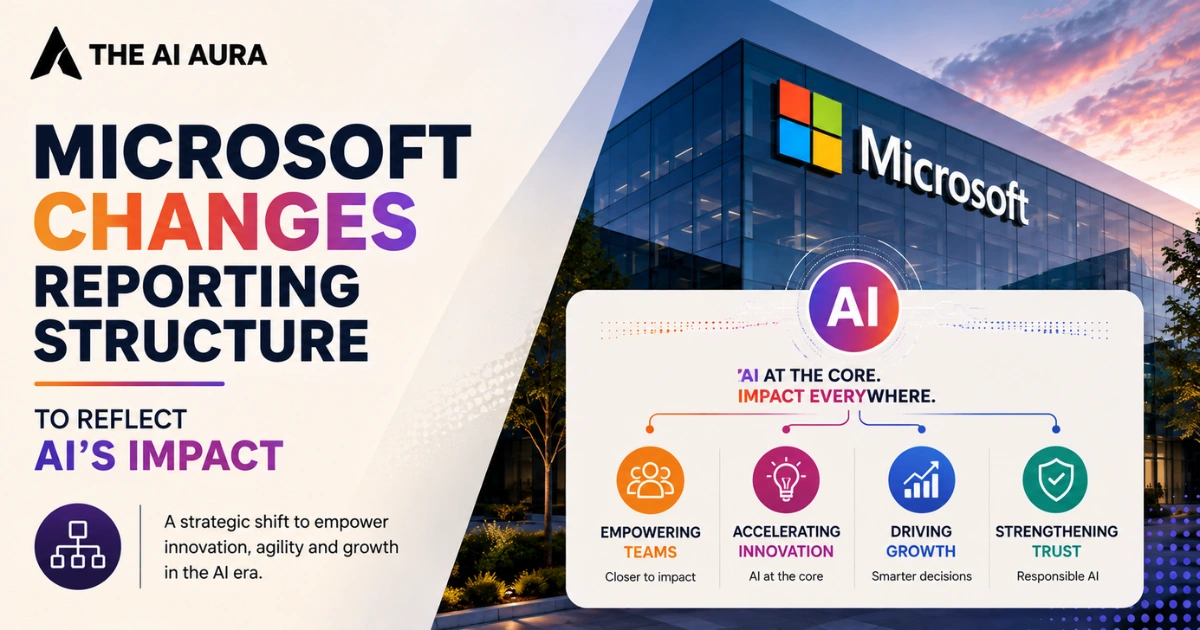
However, artificial intelligence has broken that traditional categorization. The old metrics no longer capture the reality of modern enterprise technology. Therefore, Microsoft is consolidating its financial reporting into just two segments: Agents and Infra and Devices and Consumer.
This change is far more than a routine accounting tweak. It reflects how generative AI rewired the way Microsoft builds, scales, and sells technology.
The Logic Behind Merging Agents and Infrastructure
To understand how this works on the ground, you have to look at how enterprise AI is actually deployed. Under the old reporting model, Microsoft had to artificially untangle its revenue streams.
An enterprise buying Microsoft 365 Copilot licenses would have its revenue booked under “Productivity,” while the massive computational resources required to actually run those AI models sat over in “Intelligent Cloud.”
In the era of generative AI, separating the application from the compute power makes zero sense. You cannot have an AI agent without the underlying data center infrastructure required to train, host, and execute its queries.
By creating the Agents and Infra segment, Microsoft is finally aligning its balance sheet with its engineering reality.
Enterprise clients are no longer buying cloud storage in one meeting and productivity software in another. They are investing in integrated AI ecosystems.
When a Fortune 500 company signs a contract today, they are purchasing thousands of Copilot seats while simultaneously spinning up Azure OpenAI workloads to build out their own proprietary tools.
Lumping these revenue streams together gives investors a much clearer, unfragmented view of Microsoft’s commercial AI momentum.
From a strategic standpoint, it also cleverly blends the high-margin software subscription revenue with the notoriously high capital expenditures of building AI data centers, smoothing out the financial narrative for shareholders.
Redefining the Consumer and Enterprise Divide
The second half of this reorganization Devices and Consumer acts as a necessary container for Microsoft’s legacy and hardware-centric operations. Windows OEM licenses, Surface hardware, Xbox gaming, and search advertising will now live entirely under one roof.
This restructuring forces a stark, undeniable dividing line between Microsoft’s high-growth, AI-driven enterprise engine and its more volatile, cyclical consumer markets.
For years, the old “More Personal Computing” segment was a mixed bag of hardware and software that analysts struggled to cleanly evaluate against the explosive growth of Azure.
By isolating devices and consumer services, Microsoft is allowing Wall Street to grade its consumer hardware and gaming acquisitions purely on their own merits, without muddying the waters of its enterprise AI dominance.
This move effectively sets a new reporting benchmark for the tech industry. As artificial intelligence continues to dissolve the traditional boundaries between cloud hosting and software-as-a-service, other hyperscalers will likely be forced to rethink how they report their earnings.
We are no longer operating in an economy where software and servers are sold as distinct commodities. In the current market, artificial intelligence is the product, and the infrastructure is simply the delivery mechanism. Microsoft is just the first to make its balance sheet reflect that reality.
Source: The Wall Street Journal, "Microsoft to Change Reporting Structure to Reflect Effects of AI"