
The intersection of artificial intelligence and public infrastructure has crossed a major threshold. We are no longer discussing theoretical smart cities or quiet lab tests. Instead, heavy automated machines now actively direct rush-hour commuters.
China has started deploying AI robots in real-world policing roles. The busy streets of Hangzhou now serve as a live testing ground for automated traffic enforcement.
Meanwhile, a Chinese robotics firm recently announced a humanoid machine that allegedly beats Usain Bolt’s sprint record. Urban planners and tech analysts globally should study this rapid hardware acceleration closely.
Here is how this technology works on the ground and what it means for automated public spaces.
The Mechanics Behind Hangzhou’s AI Traffic Enforcers
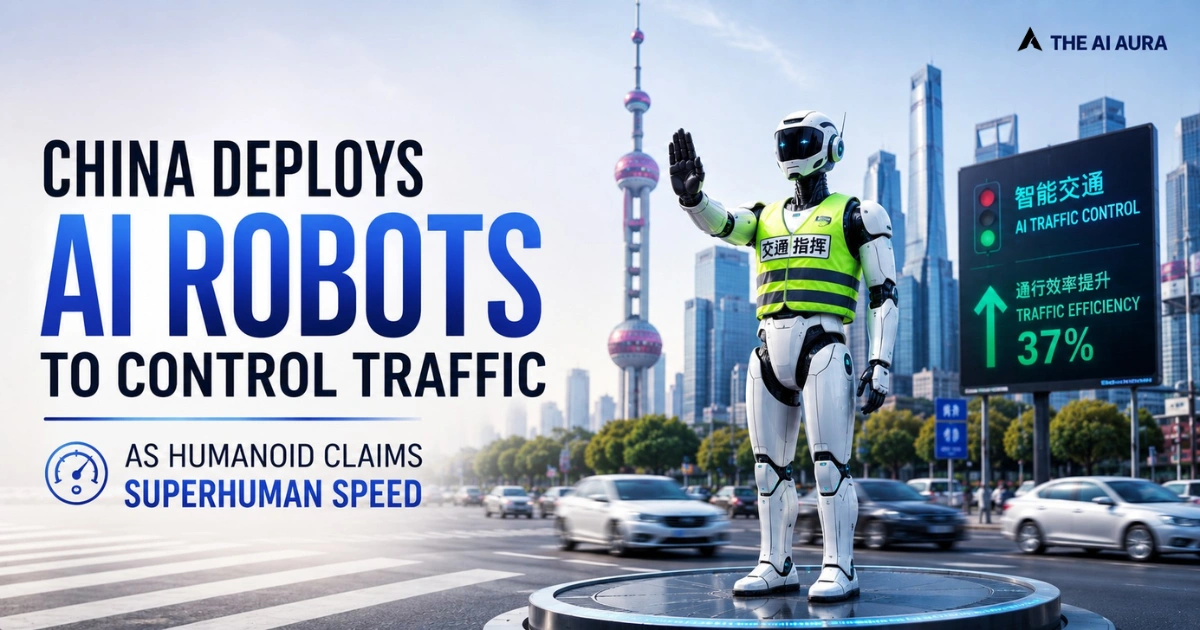
At the core of this rollout is the T2 robot, engineered by SUPCON Information. Standing an imposing 1.88 metres tall and weighing 98 kilograms, this unit isn’t just a glorified traffic light.
From an engineering standpoint, the machine relies on a highly responsive stack of optical cameras, radar arrays, and onboard edge computing to process street-level chaos in real time. It doesn’t carry a weapon, nor does it possess the authority to physically detain anyone. Instead, it functions as a highly visible, interactive surveillance deterrent.
The robot targets infractions that human officers often miss across multiple lanes. These include riders without helmets, overloaded bikes, jaywalkers, and cars crossing stop lines. When the onboard AI detects a violation, the T2 issues an immediate, targeted verbal warning.
What makes it particularly effective is its physical presence. The robot features seven-jointed mechanical arms programmed to execute standard traffic-police gestures, completely synchronized with the intersection’s signal changes. It bridges the gap between a static camera and a human officer.
If a commuter is lost, the robot acts as an interactive node, answering questions about local parking, providing directions, and instantly connecting users to human police dispatchers during an emergency.
Since May, SUPCON has deployed just 15 of these units in Hangzhou, yet they have already issued over 170,000 warnings. More importantly, the company reports a 40 percent drop in localized traffic violations a metric that, while pending independent verification, suggests a massive shift in how municipal compliance can be managed.
Pushing Hardware Limits: From Intersections to Superhuman Speed
While the T2 manages street traffic, the wider Chinese robotics sector is pushing physical agility. Another firm recently unveiled a humanoid claiming sprint speeds faster than Usain Bolt.
Building a robot that can stand at an intersection requires robust weatherproofing and localized image recognition.
Building one that can run at superhuman speeds requires a fundamental breakthrough in power-to-weight ratios, actuator responsiveness, and real-time kinetic processing to maintain dynamic balance. When you look at these two developments side by side, the trajectory of the hardware becomes clear.
We are looking at a rapidly maturing domestic supply chain for robotic components. The sensors, batteries, and AI models driving these machines are becoming infinitely more reliable and cheaper to produce at scale.
The streets of Hangzhou offer a very tangible preview of what urban enforcement looks like moving forward. The focus has shifted away from simply installing smarter cameras toward deploying interactive, physical agents that command compliance through their physical presence.
The integration of autonomous hardware into daily public life is no longer an impending concept. It has already arrived, and it is actively directing the flow of traffic.
Source: Official The Times of India, "China Puts AI 'Robocops' on Traffic Duty; 'Superman' Robot Claims Speed Faster Than Usain Bolt"