
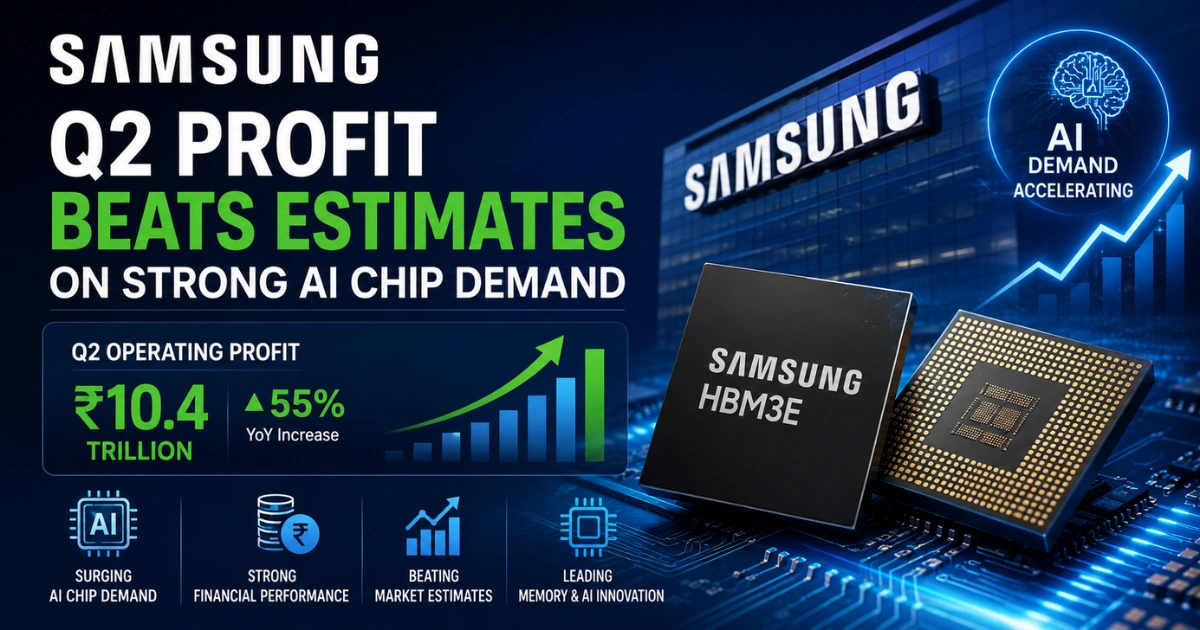

Samsung Electronics has extended its record-breaking financial run, fundamentally driven by the relentless global appetite for artificial intelligence infrastructure.
The South Korean technology giant reported a staggering 1,814% year-over-year surge in its second-quarter operating profit, reaching 89.5 trillion won ($62 billion).
Revenue also climbed significantly, hitting a record 171.5 trillion won and underscoring a broader shift in the global semiconductor landscape.
As hyperscalers and data centers race to secure computing power, Samsung’s memory division has become the undisputed engine of its current financial architecture, comfortably beating analysts’ consensus.
The AI Infrastructure Catalyst
The core driver behind this unprecedented earnings beat is the exponential growth in demand for high-performance memory components essential for AI servers.
As the industry moves toward broader adoption of agentic AI systems capable of autonomous decision-making the hardware requirements have scaled dramatically.
Samsung capitalized on this shift by scaling up sales of its high-bandwidth memory (HBM) and shipping the industry’s first HBM4E samples to major data center clients.
These specialized chips are designed specifically to eliminate data bottlenecks in advanced AI processors, such as those developed by Nvidia and Broadcom.
Beyond HBM, the company is seeing aggressive demand for server DRAM and enterprise Solid State Drives (eSSDs). These high-capacity storage devices are non-negotiable for training large language models and processing massive datasets quickly.
To maintain this momentum, Samsung is actively increasing its capital expenditure, expanding fab infrastructure in Pyeongtaek to secure long-term capacity.
Balancing Growth with Supply Chain Realities
While the semiconductor boom is yielding historic margins, it is simultaneously restructuring market dynamics. Samsung anticipates that industry-wide supply constraints will tighten further as we move toward 2027.
AI token generation is expected to surge over the next few years. As a result, leading global data centers are securing hardware several years in advance.
To address this demand, Samsung has signed multi-year supply agreements with five major global data center operators. It is also in the final stages of negotiations with five more.
This provides the company with rare, long-term visibility into future demand, allowing for highly calibrated R&D and manufacturing investments.
However, this chip-driven hypergrowth is a double-edged sword for a diversified conglomerate.
The very same elevated component prices driving Samsung’s semiconductor profits are squeezing its mobile and networks divisions.
The Galaxy S26 and A series smartphones posted solid sales. Even so, rising internal costs continued to pressure Samsung’s mobile business.
Going forward, Samsung will balance HBM and conventional DRAM production. This strategy will help the company expand its share of the high-margin AI memory market while continuing to meet traditional memory demand.
Source: CNBC, "Samsung Q2 Earnings Beat Estimates on Strong AI Chip Demand"