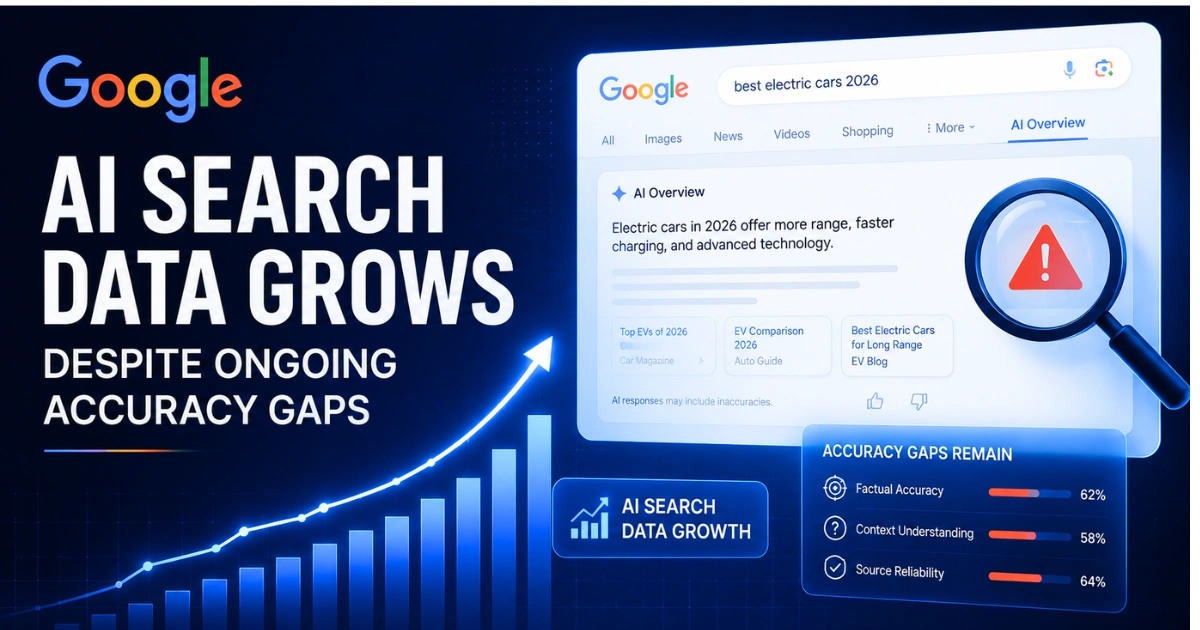

Google is slowly giving marketers a better look at how AI-powered search is changing user behavior—but the picture is still far from complete.
Since AI Overviews and AI Mode began appearing in Google Search, SEO professionals have struggled to measure their impact because Google provided little visibility into how these experiences generated traffic.
That is beginning to change. Google has quietly introduced a pilot feature called AI Performance Insights inside Merchant Center, giving selected merchants their first glimpse into how shoppers interact with AI-generated search experiences.
While the new dashboard is a welcome step toward transparency, it still leaves one of the biggest questions unanswered: Does AI Search actually drive clicks?
Merchant Center Offers the First AI Search Insights
The new AI Performance Insights dashboard, first spotted by SEO consultant Brodie Clark, appears within the Analytics section of Google Merchant Center. Instead of displaying traditional keyword reports, it groups shopping-related searches into broader themes and categorizes them based on customer intent.
Merchants can see whether shoppers are researching product specifications, comparing products, reading reviews, or exploring categories before making a purchase.
The dashboard also connects these grouped queries to different stages of the buying journey, helping businesses understand what customers want at each step.
For ecommerce brands, this information can improve product listings. If Google identifies growing demand for features such as “lightweight running shoes” or “wireless noise cancellation,” merchants can update product titles, descriptions, and feed attributes to better match the language customers are using in AI Search.
The dashboard also introduces a Share of Voice metric that compares AI visibility against competitors.
However, this metric comes with important limitations. Google only measures competitors already associated with a Merchant Center account.
If no competitors are configured, the report may incorrectly show a 100% share of voice. Likewise, accounts with very few AI impressions may display zero, even when products appear occasionally.
As a result, marketers should interpret this metric carefully instead of treating it as a reliable market benchmark.
Better Visibility, But Major Data Is Still Missing
Although the pilot marks Google’s first meaningful effort to report AI Search activity, it stops short of providing the data marketers care about most.
The dashboard currently reports impressions, showing how often products appear within AI-generated shopping experiences.
The dashboard currently reports impressions, showing how often products appear in AI-generated shopping experiences.
However, it does not report click data. Businesses can see when AI surfaced their products, but they cannot tell whether users visited their websites or completed purchases.
This limitation makes it difficult to evaluate the true return on AI Search optimization efforts. Increased visibility alone doesn’t necessarily translate into more traffic or higher revenue.
The pilot is also limited to merchants using Google Merchant Center. Publishers, affiliate websites, review platforms, and content creators competing for AI Overview visibility don’t receive the same level of insight.
Instead, they must rely on the recently introduced Search Console AI reporting, which currently provides only impression data grouped by pages and devices without revealing detailed user behavior.
Pressure for greater transparency may come from regulators rather than Google itself. The UK’s Competition and Markets Authority (CMA) has already directed Google to provide publishers with click-through and click-through rate reporting for AI-powered search features.
The company has been given nine months to implement those reporting requirements in the UK.
Whether similar reporting expands globally remains uncertain. Until Google provides complete click and conversion data, marketers will continue optimizing content for AI visibility without knowing how much business those appearances actually generate.
The latest Merchant Center pilot is an important first step, but it still leaves critical gaps that prevent businesses from fully measuring AI Search performance.
Source: Search Engine Journal, "Google's AI Search Data Is Growing, But The Gaps Remain"