
More than three years after launching ChatGPT, OpenAI appears to be broadening its target audience.
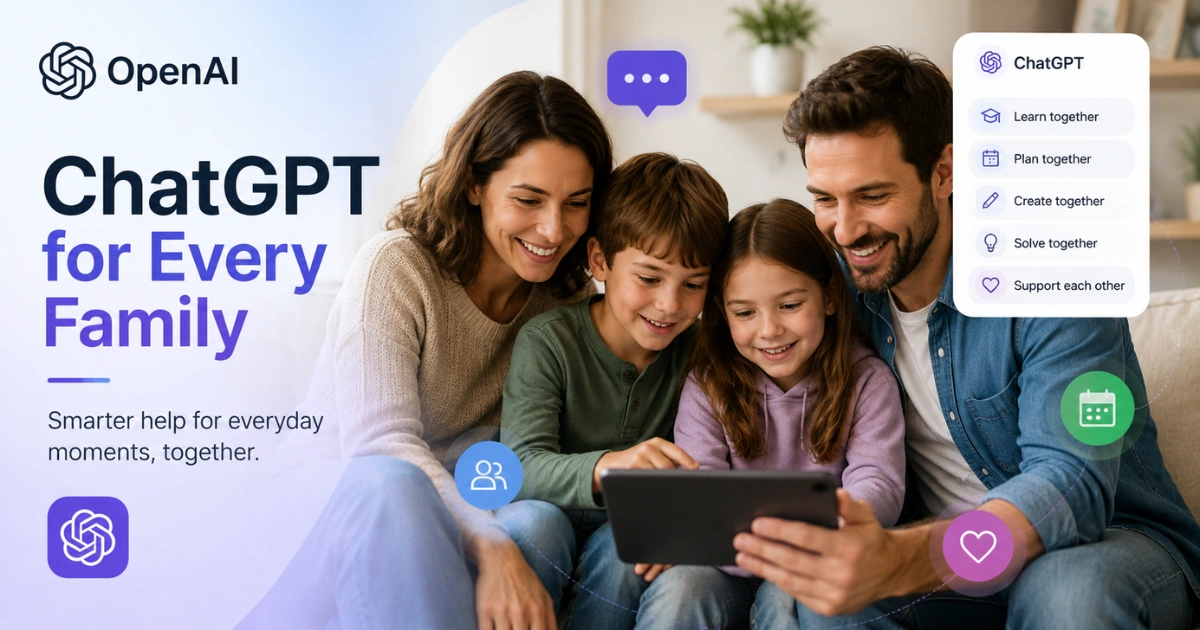
A job listing spotted by TechCrunch shows the company hiring a product manager in San Francisco to build ChatGPT experiences for families, caregivers, and older adults.
That marks a noticeable shift for a product originally designed around individual productivity.
The hiring reflects changing user demographics. Sensor Tower data shared with TechCrunch shows users aged 35 and older accounted for 31% of ChatGPT’s global audience in Q2, up from 26% a year earlier.
Meanwhile, the 18-to-24 age group declined from 34% to 29%. In the United States, nearly one in four parents using smartphones accessed ChatGPT during the quarter, compared with 16% a year earlier.
What the Hiring Signals and Why Safety Matters
Ben Bajarin, CEO of Creative Strategies, told TechCrunch that OpenAI increasingly views ChatGPT as household technology rather than an individual productivity tool.
He compared the transition to the way Google, Apple, and Meta expanded beyond personal devices into everyday family life. AI assistants, however, introduce a new challenge because they interact directly with people instead of simply managing content or hardware.
Stephen Balkam, CEO of the Family Online Safety Institute (FOSI), described the strategy as “safety by redesign.” He said many technology platforms were never built with children in mind but now need to adapt as younger users adopt them.
OpenAI faces growing pressure to strengthen those safeguards. Several parents have filed lawsuits alleging ChatGPT contributed to harm suffered by their children, including cases involving suicide.
In response, the company has introduced teen parental controls, routed distress-related conversations to specialized reasoning models, and launched a Trusted Contact feature that can notify a family member during a potential self-harm situation.
The timing also matches new FOSI research covering more than 4,000 families. The study found a noticeable perception gap. Twenty-seven percent of US parents said their children used generative AI during the previous week. By comparison, 38% of children reported using it themselves.
How ChatGPT Compares With Other AI Assistants
OpenAI is not alone in targeting broader audiences, but its user growth differs from competitors.
People aged 25 to 34 represent roughly 40% of users across ChatGPT, Claude, and Gemini. Microsoft’s Copilot serves a slightly older audience, with 20% of users aged 45 or older. That compares with 14% for Claude, 12% for Gemini, and 11% for ChatGPT.
ChatGPT still trails some competitors among older users, but it is expanding faster in that segment. Its share of users aged 45 and above increased by three percentage points over the past year.
Copilot gained two percentage points, while Claude and Gemini both lost share within the same age group.
Among US parents, Gemini currently has the widest reach at 32%, followed by ChatGPT (24%), Claude (4%), and Copilot (2%).
Bajarin expects other AI companies to follow the same direction. He believes future AI assistants will include family subscriptions, child and teen profiles, shared household memory, and dedicated tools for caregivers.
As AI becomes part of everyday life, companies are increasingly designing products for entire households rather than individual users.
Source: TechCrunch, "OpenAI Bets on Families as ChatGPT Goes Deeper Into Households"