
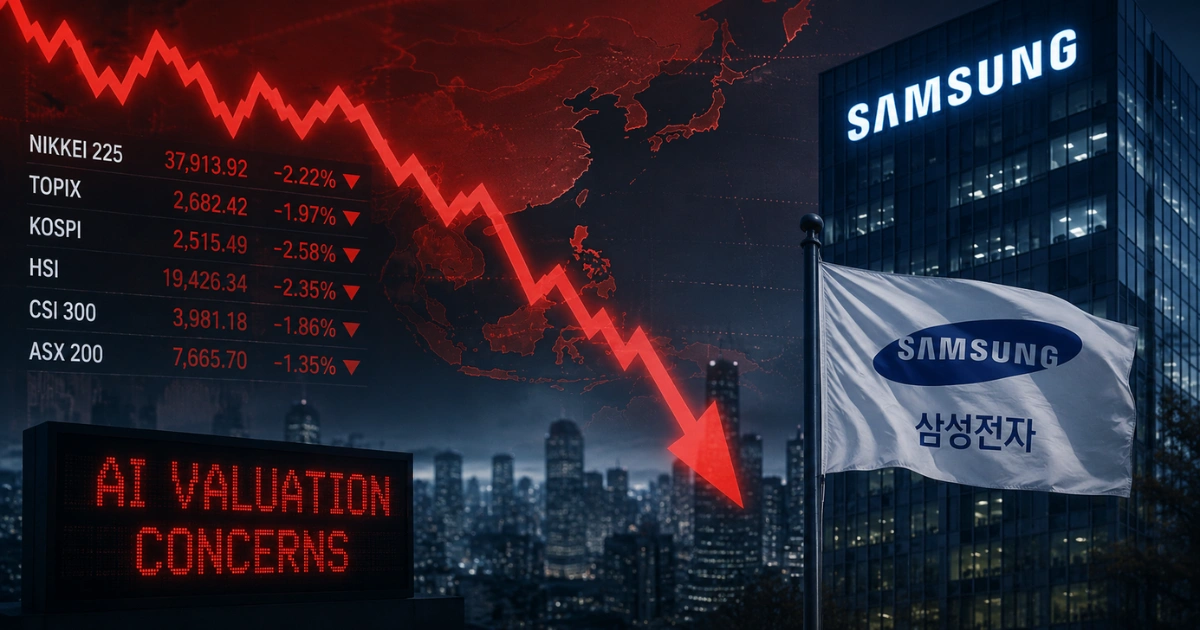

Samsung Electronics forecast one of the best quarters in its history on Tuesday, and its stock fell anyway.
That contradiction is the entire story of Asia’s trading session: a market that has stopped rewarding good AI-driven earnings the moment investors start questioning whether the earnings can keep growing fast enough to justify what chip stocks are already priced for.
The Number That Didn’t Matter Enough
Samsung forecast second-quarter operating profit of 89.4 trillion won, roughly $58.4 billion, a nearly 19-fold jump from a year earlier and ahead of what analysts had modeled, driven by surging demand and stronger pricing for the high-bandwidth memory chips that power AI servers.
On a normal day, a number like that moves a stock higher. Instead, Samsung shares fell as much as 10% before settling around an 8% decline, dragging South Korea’s KOSPI down more than 8% intraday and triggering a temporary market-wide circuit breaker before the index recovered slightly to close roughly 5.7% lower.
SK Hynix fell about 9% on the same day it formally launched the marketing process for its planned US listing.
Rajat Agarwal, Asia equity strategist at Societe Generale, put the reaction plainly: strong results without a genuine surprise, arriving after a run-up that had already priced most of the good news in, tend to get sold rather than bought.
Adding mechanical force to the drop, South Korea’s single-stock leveraged ETFs tracking Samsung and SK Hynix, now a much larger share of daily trading volume than a year ago, forced issuers to rebalance hedges as prices fell, amplifying the decline in both stocks and the broader index.
Why the Selloff Didn’t Stay in Korea
The rotation out of richly valued chipmakers spread across Asia’s entire AI hardware supply chain within hours.
Hon Hai Precision, known as Foxconn and Nvidia’s largest AI server assembly partner, fell despite reporting stronger-than-expected quarterly revenue.
Taiwan’s MediaTek dropped, TSMC reversed early gains to close lower, and Japan’s Murata tumbled 9%, pulling the Nikkei down nearly 2% and the broader MSCI Asia Pacific index down more than 1%.
Vasu Menon, managing director of investment strategy at OCBC, framed the underlying worry: if AI infrastructure investment moderates even modestly from here, memory demand growth slows with it, and that puts the profit outlook for the entire chip sector at risk, regardless of how strong any single quarter looks in isolation.
This market skepticism comes at a crucial juncture, as enterprise spenders face pressure to prove that heavy investments in the AI stack explained: models, vector databases, agents & infrastructure in 2026 are generating direct financial returns.
Rising oil prices, following reports that Iran fired missiles toward commercial vessels in the Strait of Hormuz, added a secondary drag on sentiment, though expectations that OPEC+ output increases would offset supply risk kept the move contained.
Not every regional market followed Korea down. India’s Nifty 50 rose about 0.4%, Singapore’s benchmark gained nearly 1%, and Indonesia’s index advanced 0.5%, a reminder that this is a chip-sector story more than a broad Asia growth story.
What Happens Next
What happens next depends less on Samsung’s earnings call and more on a stacked week of macro data: Philippines and Taiwan inflation figures, China’s June CPI report, a Bank Negara Malaysia rate decision Thursday, and a Reserve Bank of New Zealand decision Wednesday where markets are broadly pricing in a 25-basis-point hike.
Investors will also comb through Wednesday’s Federal Reserve minutes for signals on US rate policy after softer labor-market data cooled expectations of further tightening.
Corporate leaders are closely watching these broader fiscal indicators as they map out future technical roadmaps, moving past experimental setups to manage why 80% of ai projects fail (and how the top 20% actually make money) in an increasingly cost-conscious economic environment.
None of that changes the core question hanging over the sector: whether the earnings season now getting underway can prove that record AI-driven profits translate into stock prices that were reasonable to begin with, or whether Tuesday’s reaction to Samsung is the first sign that the market has simply stopped giving chipmakers the benefit of the doubt.
Source: Official UC Berkeley News – "With AI, Researchers Discover New Way to Detect Sudden Cardiac Death Risk"