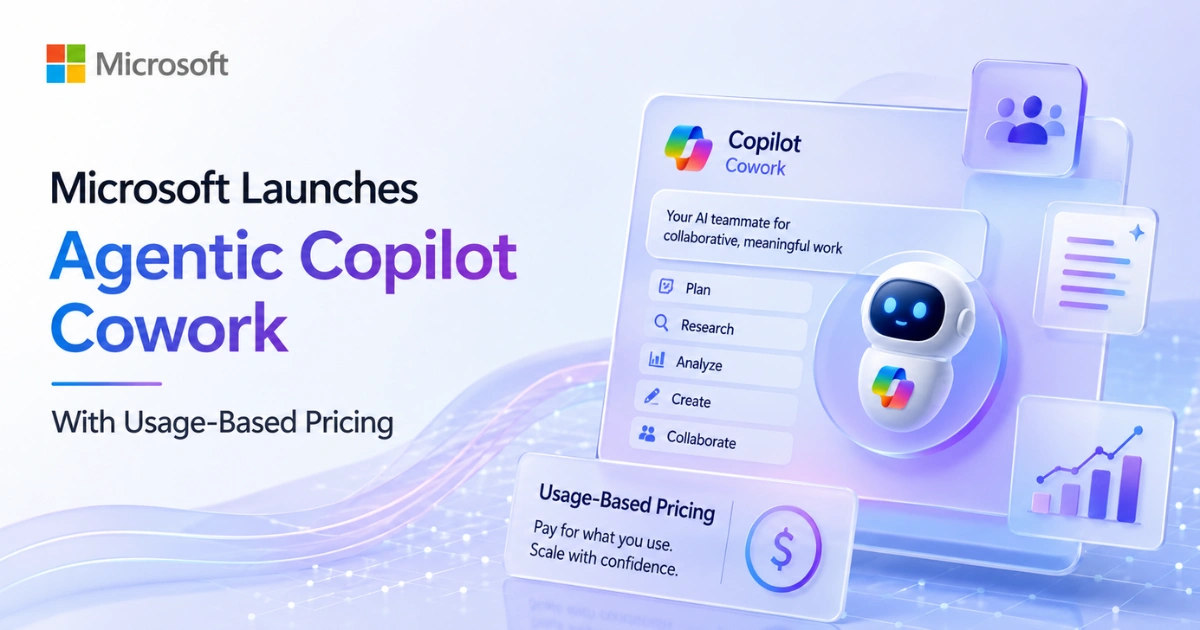

Microsoft rolled out Copilot Cowork worldwide this week, and buried in the announcement is a pricing change that might matter more than the product itself.
Cowork is Microsoft’s attempt to make Copilot more than just a chat window inside Office.
According to Fast Company’s reporting, Copilot lead Charles Lamanna has been pushing internally for this exact distinction: instead of asking the AI how to handle a task, you hand it the task — pulling figures from Excel, drafting and sending Outlook follow-ups, stringing several steps together without someone supervising each one.This transition marks a major industry shift from chatbots to agents.
That’s the product story. Here’s the part worth paying attention to.
Why Microsoft’s Pricing Change Matters More Than Copilot Cowork
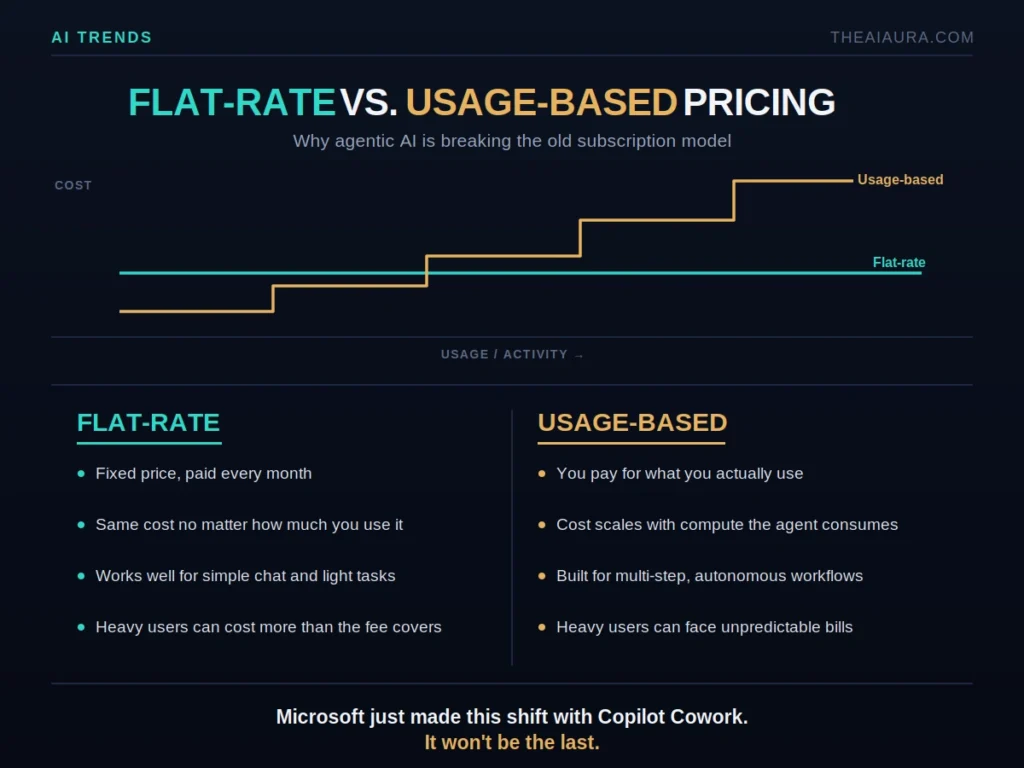
Microsoft is moving Copilot off flat-rate pricing and onto a usage-based model. TheStreet reported the reason bluntly: power users running heavy, multi-step agent tasks were costing Microsoft more in compute than the flat subscription ever covered. Enough users were hitting that ceiling that the old pricing model simply broke. This situation highlights the AI cost trap: what companies don’t budget for when deploying advanced AI systems.
That detail tells you more about where agentic AI is headed than the product launch does.
A chatbot conversation costs roughly the same whether you ask it one question or ten. An agent completing a multi-step task may trigger dozens of tool calls behind the scenes. The cost scales with the amount of work delegated, not how often someone opens the app. Flat pricing doesn’t survive that math for long.
Microsoft isn’t the only company running into this. Two days before Cowork’s launch, GitHub shipped its own “agent finder” tool for Copilot. The tool helps agents discover which tools and skills they can use.
And a separate draft specification backed by Google, Microsoft, and GitHub, published this week, standardizes exactly that: how agents find and verify tools online. Three companies solving adjacent pieces of the same problem in the same week isn’t proof of an industry-wide shift on its own — but it’s a specific, dated pattern, not a vague one.
The quiet part of this story isn’t that Microsoft built an agent. Everyone’s building agents. It’s that Microsoft just admitted, through its pricing model, that agents cost money in a way chat never did — and the rest of the industry is about to learn that the hard way too.