
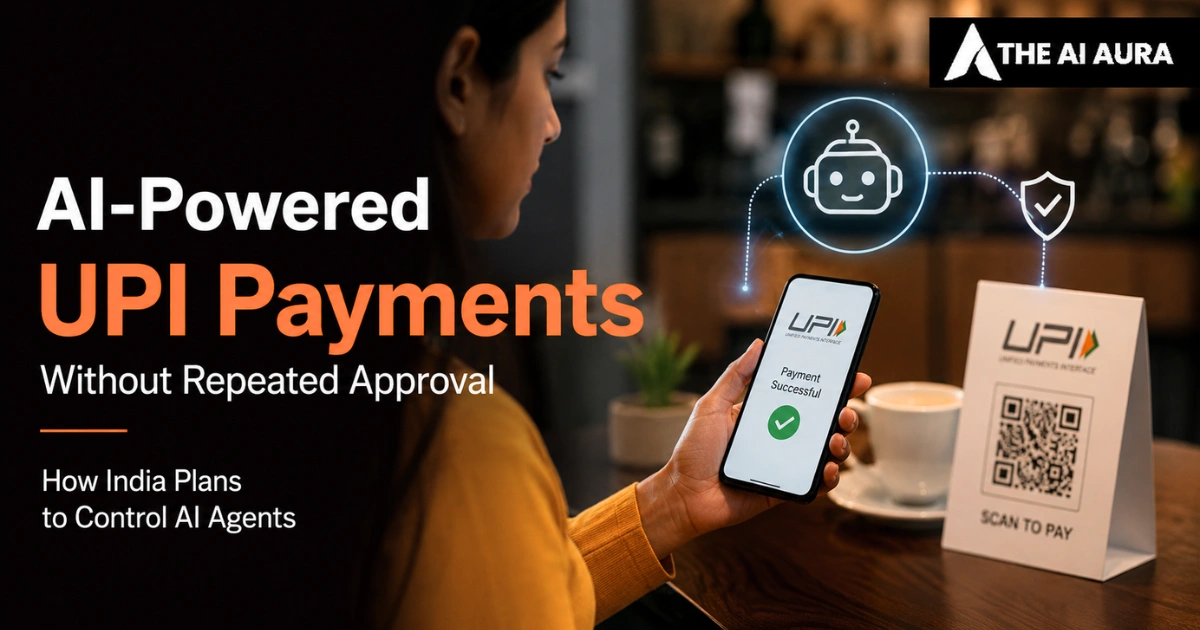

India’s digital payment ecosystem has steadily matured from SMS-based OTPs to seamless facial and fingerprint authentication. But the next frontier goes beyond human input entirely: autonomous, hands-free transactions executed by artificial intelligence.
According to recent reports, the National Payments Corporation of India (NPCI) is developing a framework known as the Unified Agent Protocol (UAP), designed to allow AI agents to independently initiate and complete small-value UPI transactions based on pre-set user parameters.
This marks a significant shift from a user-operated payments network to an infrastructure built for agent-led commerce.
Rather than approving every individual transaction, users could grant an AI agent restricted financial autonomy to monitor prices, apply discounts, and complete purchases automatically.
While this promises a massive leap in convenience for high-frequency, low-value transactions like grocery shopping, delegating financial authority to a software agent requires rigid structural guardrails.
The Mechanics of Agent-Led Commerce
The UAP is expected to leverage two existing UPI capabilities to function securely without repeated PIN entries. The first is UPI Circle, a feature that currently allows a primary account holder to delegate payment authority to secondary users.
Under the new protocol, this delegation mechanism would be adapted to authorize verified AI agents instead of human contacts.
The second pillar is Reserve Pay, a feature enabling customers to block a specific amount of funds currently up to Rs 10,000 for up to 90 days for multiple future debits.
By combining these two mechanisms, the system can ensure AI agents operate within a tightly controlled sandbox. A user could instruct their AI assistant to handle daily consumable orders, capping the spending limit and restricting transactions exclusively to registered e-commerce merchants.
Advanced applications may eventually extend to automated investments, where an AI triggers a purchase the moment an asset hits a specific price threshold, completely bypassing manual intervention.
Establishing Liability and Security Safeguards
Handing over the purse strings to an algorithm introduces complex regulatory challenges, primarily surrounding liability.
If an AI agent exceeds its authority, authorizes an erroneous purchase, or falls victim to a manipulated prompt, the financial ecosystem must have clear rules on who absorbs the loss: the consumer, the bank, the payment app, or the AI provider.
To mitigate these risks, the proposed NPCI framework relies on strict identity checks, granular transaction audit trails, and merchant integration controls. The AI does not gain blanket control over the user’s bank account; it operates strictly on pre-authorized, rule-based instructions.
By creating a unified national layer for agentic transactions rather than leaving it to proprietary closed-loop networks, India is attempting to standardize AI commerce safely, ensuring that convenience does not compromise financial security.
Could AI Agents Automate Your UPI Payments?
This broadcast outlines how the upcoming Unified Agent Protocol will enable AI systems to securely manage routine digital purchases within India’s UPI ecosystem.
Source: The Times of India, "Your AI May Soon Be Able to Pay for Things Through UPI Without Asking Every Single Time: Here Is How India Plans to Control It"