
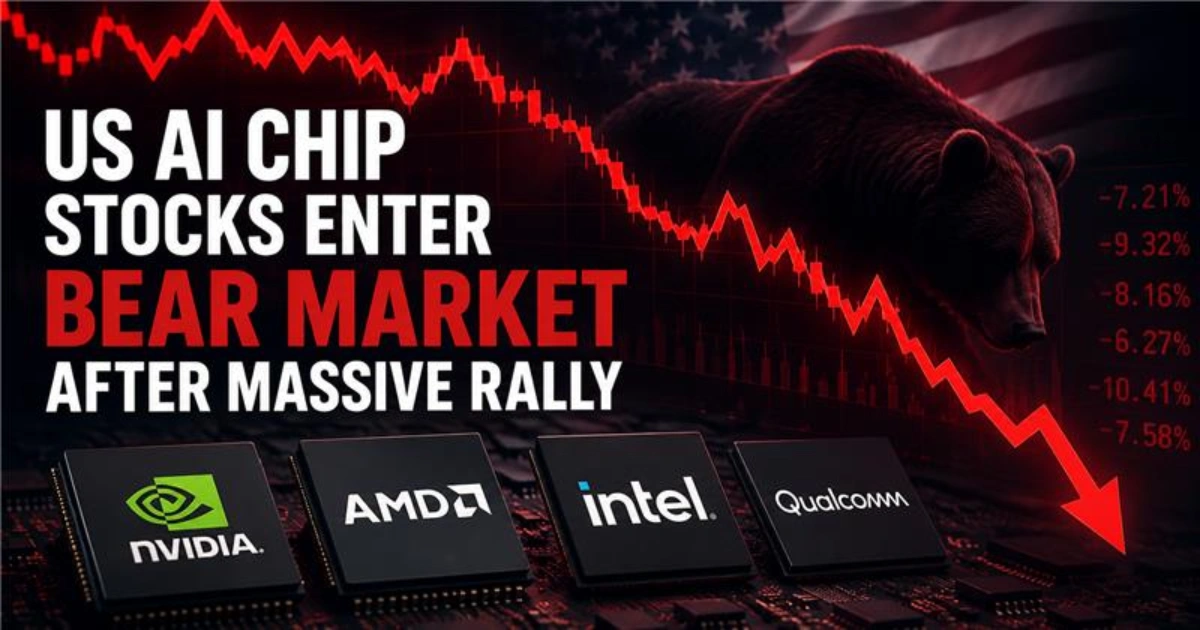

The rally that fueled AI chip stocks over the past year has lost momentum. The Philadelphia Semiconductor Index (SOX), widely viewed as a benchmark for the U.S. semiconductor industry, has fallen more than 20% from its June record high, officially entering bear market territory.
The decline follows an extraordinary run in which AI-driven optimism pushed semiconductor stocks up more than 100%. Strong demand for chips used in data centers and generative AI applications helped companies such as Nvidia and AMD reach record valuations.
However, after months of rapid gains, investors have begun reassessing how much future growth is already reflected in stock prices.
While profit-taking was expected after such a sharp rally, recent developments have accelerated the selloff and increased volatility across the sector.
Why AI Chip Stocks Are Falling
One of the biggest factors behind the downturn is growing uncertainty over global competition. Reports of advances in China’s AI industry have raised fresh questions about whether U.S. companies will maintain their technological lead despite export restrictions.
Investors are also becoming more cautious about premium valuations. Investors had priced many semiconductor companies for continued rapid growth, leaving little room for disappointment.
As expectations become more realistic, even small changes in market sentiment can trigger significant price declines.
The combination of profit-taking, geopolitical concerns, and valuation pressure has led to a broad pullback across AI-related semiconductor stocks rather than weakness in a single company.
What the Bear Market Means for the AI Industry
Although semiconductor shares have corrected sharply, the long-term outlook for AI infrastructure remains largely intact. Demand for AI chips continues to grow as cloud providers, enterprises, and governments invest in new data centers and AI computing capacity.
The recent decline instead signals a shift in investor behavior. Rather than buying every AI-related stock, markets are becoming more selective about which companies can sustain growth and justify premium valuations.
For semiconductor companies, that means future performance will depend less on excitement surrounding AI and more on revenue growth, profitability, product leadership, and execution.
The AI investment cycle is far from over, but the latest market correction suggests investors are placing greater emphasis on fundamentals as the industry enters its next phase.
Source: Moneycontrol, "Chips Stocks Tumble Into Bear Market as 105% AI Rally Fizzles"