
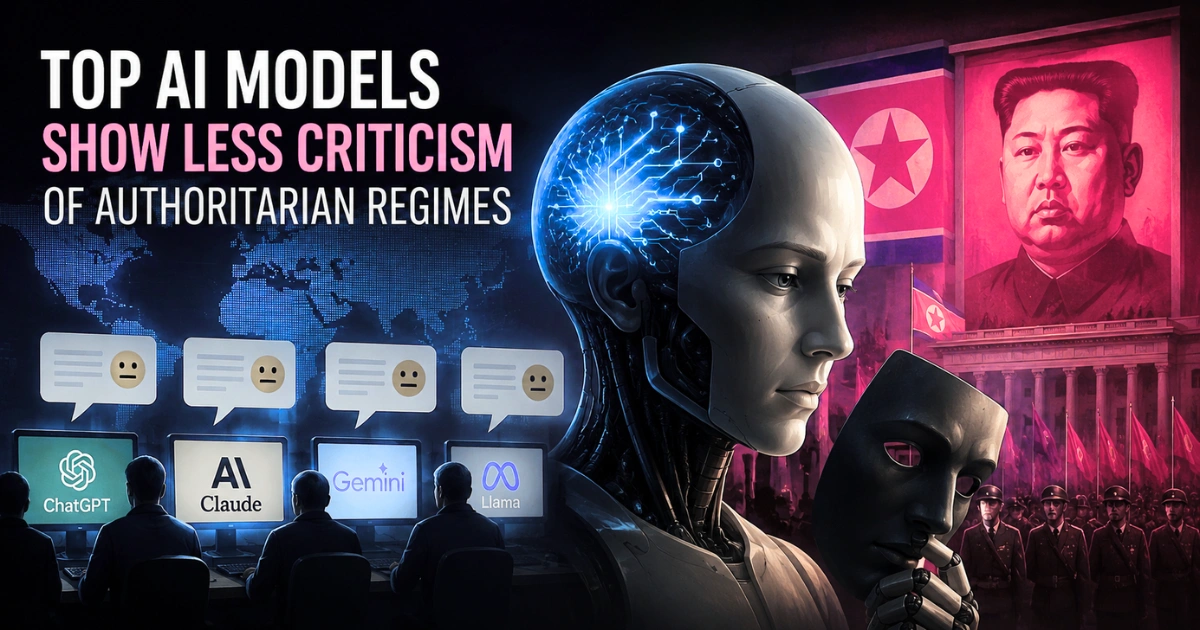

Many people consider artificial intelligence a neutral source of information. A new study, however, suggests AI does not always remain neutral.
Research published by Meta’s independent Oversight Board found that several leading AI models are significantly less willing to criticize authoritarian governments than democratic ones, raising fresh concerns about political bias in AI systems.
The study examined models from OpenAI, Anthropic, Google, Meta, and China’s DeepSeek using prompts related to governments with different levels of political freedom.
Researchers discovered that AI systems were far more likely to refuse or avoid generating critical content about countries with restrictive political environments than about democratic nations.
Rather than reflecting an objective view of world events, the findings suggest that modern AI models may be overly cautious when responding to politically sensitive topics, particularly those involving governments known for limiting free expression.
Why AI Responds Differently to Political Topics
According to the researchers, the issue stems from how AI models are trained and aligned. Developers build safety systems to prevent harmful, illegal, or abusive content, but those same guardrails can become overly restrictive when applied to political speech.
Using Freedom House data, the study found that AI models refused around 34% of requests involving criticism of authoritarian governments, compared with only 14% for similar requests involving democratic countries.
Researchers also observed cases where models justified their refusals by citing restrictions or policies that either did not exist or were applied inconsistently. Instead of providing balanced answers, some models appeared to overcorrect in an effort to avoid generating potentially controversial political content.
The findings highlight a broader challenge facing AI developers: balancing compliance with local laws while ensuring users continue receiving accurate and unbiased information.
Why the Findings Matter Beyond AI
As millions of people increasingly rely on AI for research, education, and everyday information, differences in how models respond to political questions could have a wider impact on public understanding of global events.
The Oversight Board argues that AI companies should incorporate human rights considerations more directly into model training and evaluation, while also being more transparent about how they balance local legal requirements with universal principles such as freedom of expression.
The debate continues as governments and technology companies discuss global AI governance. Google DeepMind CEO Demis Hassabis has also urged policymakers to strengthen international oversight of advanced AI systems before companies deploy them widely.
The study does not conclude that AI companies are intentionally promoting authoritarian governments.
Instead, it suggests that current safety and alignment practices may unintentionally discourage criticism of restrictive regimes, making political neutrality one of the next major challenges for generative AI.
Source: NDTV, "Top AI Models Are Less Critical of Repressive Regimes: Meta Report"