

The most-quoted statistic in the AI water debate is the claim that ChatGPT uses a bottle of water to answer a 100-word prompt.
That figure comes from a 2024 Washington Post analysis conducted with researchers from the University of California, Riverside, who estimated the water and electricity required for GPT-4 to respond to an average 100-word prompt in a typical US data center. It’s a useful illustration, but it isn’t a fixed amount attached to every AI query.
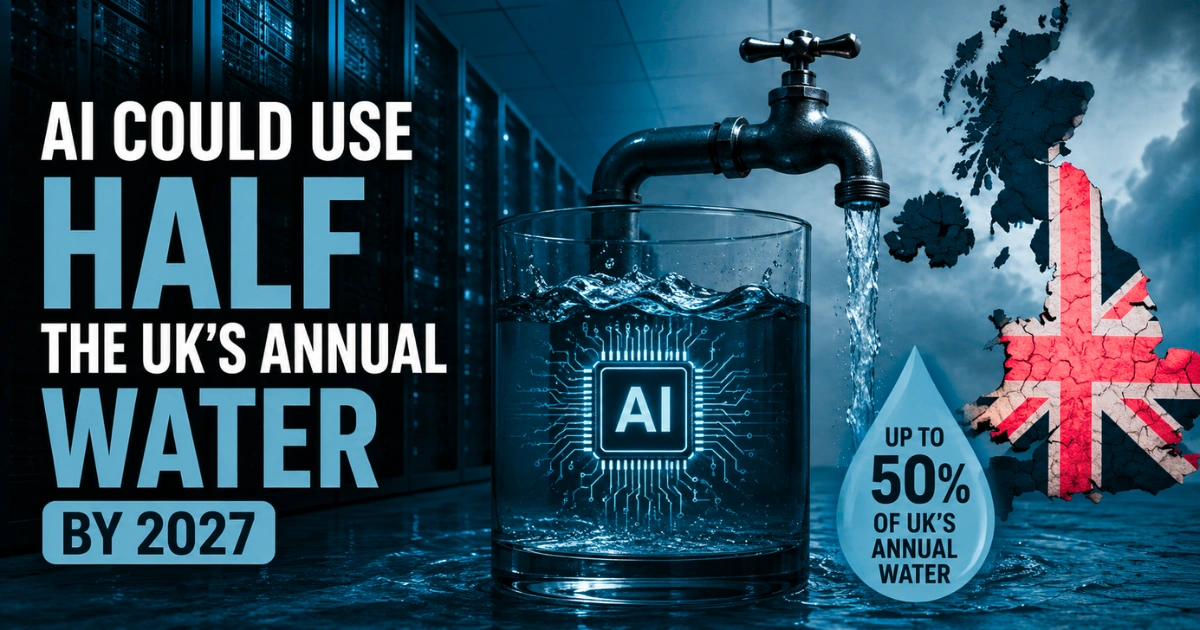
The more important figure sits beneath that headline: a peer-reviewed projection estimating that global AI demand could require between 4.2 and 6.6 billion cubic meters of water withdrawals by 2027—roughly half of the United Kingdom’s total annual water withdrawals.
Where the Numbers Actually Come From—and Why They Differ
The underlying research comes from Pengfei Li, Jianyi Yang, Mohammad A. Islam, and Shaolei Ren, whose paper Making AI Less Thirsty estimated that a model like GPT-3 could consume roughly 500 milliliters of water across 10 to 50 medium-length responses, depending on where and when it runs.
That estimate is easy to oversimplify. In fact, a 2026 Guardian analysis later corrected an earlier version that mistakenly applied the 500-milliliter figure to every individual 100-word prompt instead of the broader response range described in the original study.
The picture becomes even more complex when compared with Google’s own measurements.
A 2025 Google research paper analyzing Gemini Apps reported a median water use of just 0.26 milliliters per text prompt—roughly five drops.
These findings don’t contradict one another. Instead, they measure different AI systems, infrastructure, and accounting methods.
Some studies count only the water withdrawn directly for cooling at a data center, while others include the water consumed indirectly through electricity generation. Without standardized reporting, comparing these numbers often leads to misleading conclusions.
Why Location Matters More Than Any Single Statistic
Water is fundamentally different from carbon emissions. A ton of CO₂ has the same climate impact no matter where people emit it, but withdrawing one liter of water from a river in a water-rich region is not equivalent to extracting one liter from an already stressed aquifer.
That distinction explains why a 2026 Guardian analysis found that 517 of 809 planned US data centers are located in areas that experienced drought conditions during the previous year.
It also explains why Associated Press reporting in 2023 highlighted that Microsoft-backed OpenAI infrastructure in West Des Moines, Iowa, consumed about 6% of the local water district’s monthly supply just weeks before GPT-4 completed training.
A 2026 paper titled Small Bottle, Big Pipe by Yuelin Han, Pengfei Li, Adam Wierman, and Shaolei Ren shifts the discussion from individual AI prompts to infrastructure planning.
The researchers estimate that, if current water-use intensity continues, US data centers could require hundreds of millions of gallons of additional water capacity every day through 2030, making water availability a public infrastructure challenge rather than simply an operational efficiency issue.
The distinction matters because data centers don’t just consume water after they are built—they also place additional demands on local water systems, which must reserve capacity for peak summer cooling.
In many regions, that demand arrives precisely when communities are already experiencing their highest levels of water stress.
Source: ScienceBlog, "Writing a Single 100-Word Email with ChatGPT Consumes Approximately the Volume of a Standard Bottle of Water"